Product Overview
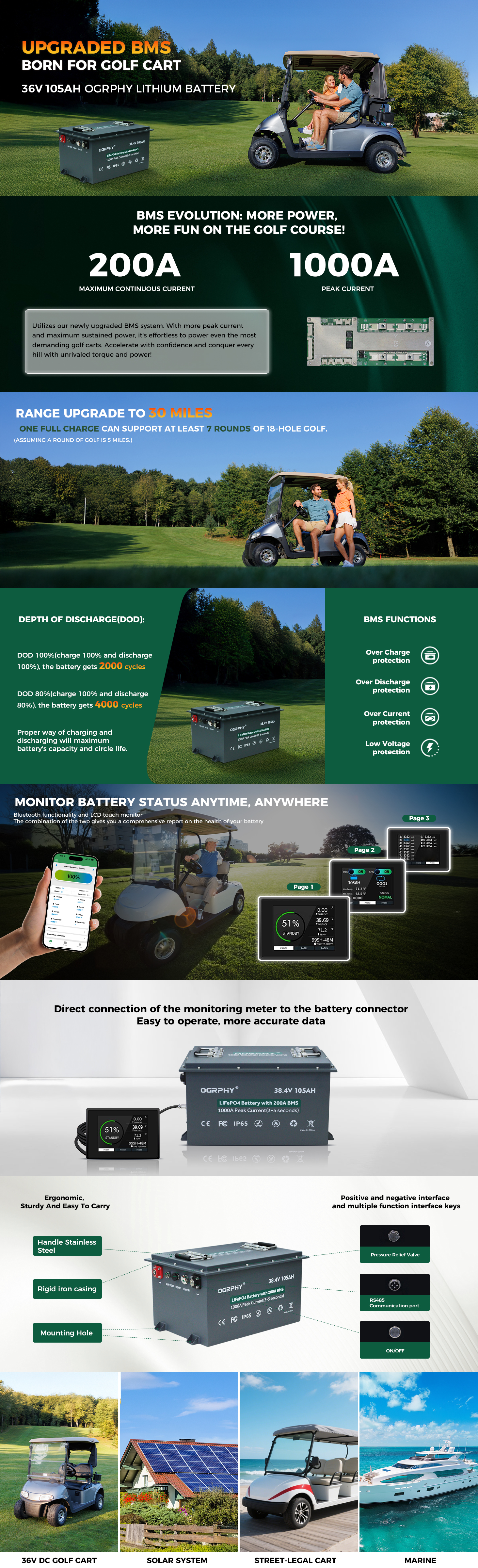
The 36V 105Ah pack is a lithium iron phosphate battery built for carts that run a 36-volt system — the six 6V or three 12V lead-acid blocks you are most likely taking out. It is a 36V lithium golf cart battery in the practical sense: it drops into a standard 36V tray, lands on the cart's existing cables, and is designed around the controllers used by the major cart brands, so the swap does not turn into a rewiring project. Three kinds of buyer end up here. A cart owner whose old set no longer finishes a round; a repair shop that wants one pack on the shelf that will fit most of the 36V carts coming through the door; and the operator of a utility cart or a 36V trolling motor who is tired of voltage sag halfway through the day. The common thread is that the cart has to work tomorrow, not after a controller upgrade. Day to day there is nothing to do. No watering, no equalising charge, no acid smell in the garage, and no separate lifepo4 battery charger to hunt down — the one in the box is matched to the pack. The touch monitor on the front panel tells you where the pack stands before you set off, and the same readings reach a phone through the app when the cart is already parked across the yard. It is not a starter battery, and it is not a drop-in for a 48V cart.
Specifications
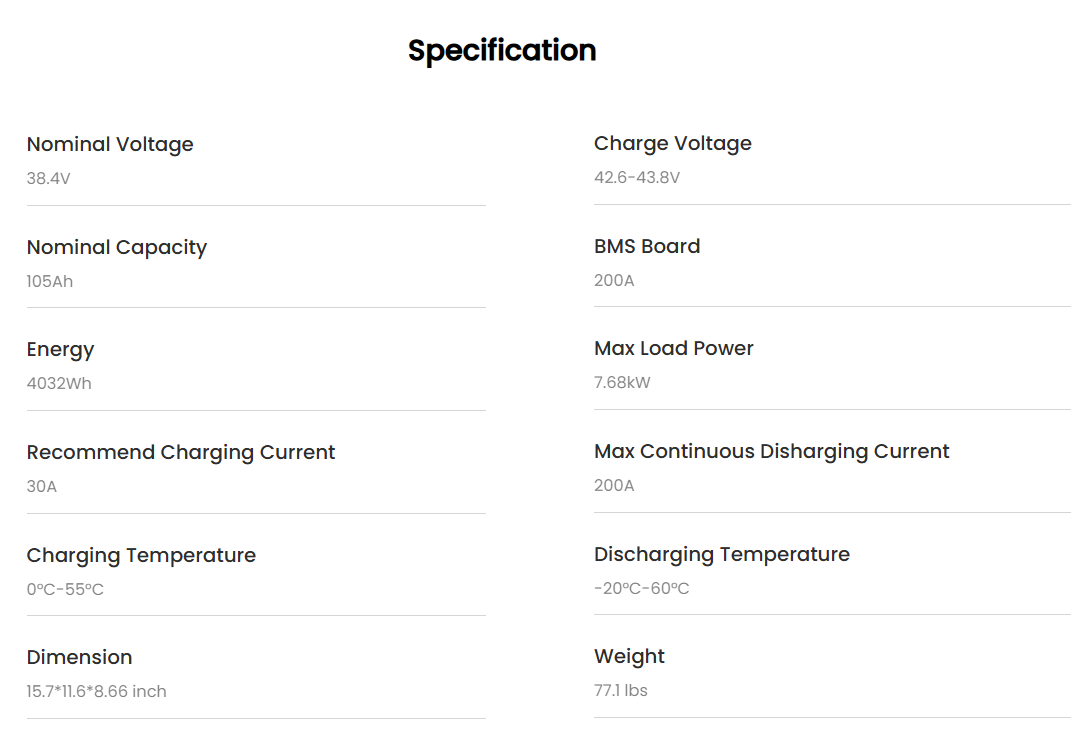
| Chemistry | LiFePO4, grade A prismatic cells (UL certified) |
| Nominal voltage | 36 V |
| Capacity | 105 Ah / 4.03 kWh |
| Continuous discharge current | 200 A |
| Peak discharge current | 1000 A for 3–5 seconds |
| Maximum continuous output | 7.68 kW |
| Peak output | 38.4 kW |
| Cycle life | 4000+ cycles at 80% depth of discharge |
| Supplied charger | 38.4 V 25 A, fan-cooled, charge status light |
| Dimensions (L × W × H) | 15.7 × 11.6 × 8.66 in |
| Weight | 77.1 lb |
| Case and handles | Ferroalloy shell, stainless steel handles, pressure relief valve |
| Monitoring | LCD touch monitor and mobile app |
Current Delivery and BMS
- A continuous rating you can lean on. The pack holds its full continuous current through the discharge rather than tapering after the first few minutes, which is what a loaded cart asks for on a long climb or a soft fairway.
- A peak that covers the launch. Pulling away from a standstill, spinning out of a bunker or climbing a curb draws a short burst many times the running current; the BMS rides it out instead of cutting the drive.
- The timed steps in between. Between the peak and the continuous rating the limit steps down through bands measured in tens of seconds — exactly the shape of a sustained climb with four adults aboard.
- Stepped limits, not a hard cut. Because the ceiling is reduced in stages rather than switched off, a steep driveway costs you speed, not the rest of the round.
- Protection on every channel. Over-charge, over-discharge, over-current, high and low temperature and short circuit are all handled inside the case, so there is no external fuse to source and no reset button to hunt for.
- Matched grade A cells. The prismatic LiFePO4 cells are UL certified and matched before assembly, so one weak cell is not setting the pace for the whole pack; this is a deep cycle lithium battery built to be worked daily, not stored for emergencies.
- Case, handles and vent. A ferroalloy shell protects the cells in a crowded bay, stainless handles take the lift when the pack comes out, and the pressure relief valve gives a controlled vent path if a cell ever faults.
- Compared with lead-acid deep cycle batteries, the pack holds its voltage under load instead of sagging through the second half of the discharge, which is why the cart feels strong at the end of the day rather than tired.
Fitting and Installation
- Confirm the system voltage. Six 6V blocks or three 12V blocks in series mean a 36V cart; four 12V blocks mean 48V and a different pack. Check the controller label or the charger's rating if the old set is already out.
- Read the controller before you buy. This golf cart lithium battery is built around the controllers used by the major cart brands; if the label is faded, photograph it with the model year and send it over so we can confirm before dispatch.
- Measure the tray against the dimensions above. Leave slack for the main cables and the monitor lead to bend without kinking; the case is compact, but a tight tray still needs a route for the wiring.
- Isolate and lift out the old set. Negative terminal first, then positive, then the hold-down. Take the old 36V golf cart batteries out, clean the tray and check for corrosion underneath — a corroded tray will chew at a new pack's case edge.
- Set the pack in dry. The stainless handles take the weight between two people, and the flat base sits on the tray without a bracket on most carts.
- Reconnect and tighten. Positive first, then negative, both terminals firmly seated; a loose terminal is the most common reason a fresh pack reads dead on the first trip.
- Plug in the monitor and switch on. The front-panel switch wakes the display; check pack voltage and state of charge before the drive circuit goes back on.
- Charge before the first run. A full charge balances the pack and gives you a clean baseline to judge the first round against.
Charging and Monitoring
A charger is only right for a pack when its profile matches the chemistry. The golf cart battery charger supplied with this one is set for LiFePO4 and takes the pack from flat to full in under five hours — quick enough to top up between shifts, or overnight without planning the day around it. A lead-acid charger tapers off at a voltage these cells never reach, which leaves you short on range with no warning light to tell you why. The front panel carries the power switch, the communication port and the pressure relief valve within reach, so nothing has to come out of the cart for a routine check. Run the monitor's cable to the port, switch on, and the screen shows state of charge, current, voltage and temperature, with a time-to-empty estimate that updates as the load changes. Readings are split across three pages, so the summary can stay on state of charge while the detail pages wait for the day something looks off. The same figures reach a phone over Bluetooth through the app, which matters more than it sounds when the cart is under a cover at the back of the yard and you want to know whether it needs charging before you walk out. The light is worth knowing — red for power, flashing green at roughly 80%, steady green when the pack is full.
Runtime, Range and Cycle Life
- 30–50 miles on a 3 kW cart, measured in testing. That is the band the pack covered with a 3 kW motor. Read any range claim that way: the number moves with terrain, load and temperature, so plan on the lower half on a hilly course.
- A round of 18 sits inside the low end. Even at the bottom of the band you have distance in hand for the round plus the trip back to the shed, which is the figure that matters when the cart is not charged at the clubhouse.
- What pulls the number down. Four adults instead of two, soft or wet turf, under-inflated tyres and cold mornings all cost miles. Check tyre pressure before you blame the pack.
- Built for years of daily cycling. The cycle rating is set at a deep discharge rather than a gentle one, and it runs many times the life of the lead-acid deep cycle batteries this pack replaces.
- How capacity fades. Lithium loses capacity gradually rather than falling off a cliff, so an older pack still covers the short runs while you plan the replacement instead of being stranded by it.
- Fleet arithmetic. Running several 36V golf cart batteries across a course changes the workload more than the fuel bill — the watering, testing and mid-season set swapping largely disappears.
- Stepping up from a smaller pack. If you are coming from a smaller lithium battery for golf cart, the difference you notice first is not top speed but the absence of sag on the last three holes, when a smaller pack is down to its final few percent.
- Charging habit sets the lifespan. Partial charges after each round suit this chemistry better than running it flat and recharging from zero every time.
Storage and Maintenance
A Pack Left Flat
Leave a lithium pack discharged long enough and the BMS does the sensible thing: it opens the output and the cart goes dead before the cells are dragged any lower. That is protection rather than failure, and the charger that ships with this pack carries a 0V charging function for exactly this situation — connect it, give it time, and the display wakes once the pack climbs back above the cut-off. If the screen is still dark after a full charge cycle, stop there and get in touch rather than opening the case.
Off-Season Routine
Store the pack with charge in it, since a half-full pack over winter is far kinder than an empty one, and put it back on the charger roughly once a month through the quiet season instead of waiting for the first warm week. Long idle gaps are easier on a deep cycle lithium battery when it is topped up now and then, and a monthly check is also the cheapest way to catch a problem while there is still time to act on it. A pack that has sat in a freezing shed should come up to room temperature before it is charged, and the front-panel switch or the app will tell you where it stands without pulling it out of the cart.
Fleet Rotation
With several 36V golf cart batteries in service, the quiet season becomes a rotation rather than a repair list: one cart a week onto the charger, the reading logged against the cart number, and the terminals checked for tightness as each one goes back into use. The whole round of checks fits into a coffee break per cart, which is a different order of effort from what the old lead-acid set asked for, and it is the part of the switch that fleet managers notice first.
Ordering and Delivery
- Run the fit check first. Send the cart's make, model year and controller label — the same check any shop runs before fitting a lithium battery for golf cart — and we will confirm the pack suits your 36V system and flag anything the tray or cables need.
- Pick the dispatch point. Stock is held in the local warehouse, and checkout also offers a China dispatch; choose local if the cart is needed this week.
- Lead times. Stock orders are processed in 3–7 days. For a custom or non-stock configuration, allow about 35 days.
- Shipping. Orders leave local stock with Swift Delivery and take 3–7 days for shipping once dispatched.
- Warranty. The pack carries a 5-year warranty; keep the order confirmation, because that is what a claim is checked against.
- What arrives. Pack, touch monitor and cable, and the matching lifepo4 battery charger — a complete kit, with no separate accessories to order.
- Shops and fleets. If you are fitting several carts, place them as one order and list the models; a golf cart lithium battery order for six carts is picked and dispatched together, and quantity and current terms are confirmed before it goes out.
About Our Company
Xinyubattery is the brand of Shenzhenshi Xinyu Newenergy Technology Co.,LTD, a Shenzhen-based company founded in 2016 and working in green power solutions for more than ten years. Through a vetted network of production partners, we bring a broad range of power products together in one place and consolidate each order for you. Products are checked before dispatch, packed for export and shipped from local stock, and our team stays available for technical advice, fitting questions and after-sales help.
FAQ
How do I know my cart is 36V and not 48V?
Count the blocks under the seat: six 6V batteries or three 12V batteries wired in series add up to 36V, while four 12V blocks mean a 48V cart. The controller and charger labels confirm it. If the cart has been converted before, send a photo of the pack and the controller and we will read it with you before you order a 36V lithium golf cart battery.
Can I keep using my old golf cart battery charger?
No — the profile is wrong for lithium. A lead-acid charger tapers at a lower voltage, so the pack never reaches full and you lose range with no fault showing. Use the lifepo4 battery charger that ships with the pack; it is set for this chemistry and finishes the charge properly.
Will it fit a cart that has already been converted to lithium?
Usually yes, but a converted cart is worth checking first. Tray brackets and cable lengths are often changed during a conversion, so send photos of the bay, the existing pack and the controller. This golf cart lithium battery is designed around the controllers of the major cart brands, and the front port panel needs a clear run for the monitor cable.
What does the app show that the screen does not?
The same readings — state of charge, current, voltage and temperature — over Bluetooth, which is handy when the cart is under a cover or in a shed. Use it to watch how much you draw on a normal round, and if you are moving up from a smaller lithium battery for golf cart, that number is the one to size the next pack against.
What happens if the pack is left discharged for a long time?
The charger has a 0V charging function that can wake a pack that has dropped into low-voltage protection: connect the supplied charger and give it time. If the display stays dark, contact us before opening anything. A deep cycle lithium battery of this kind prefers being topped up, so a monthly top-up in the off-season is easier on it than a full discharge followed by months of storage.
Does it need any maintenance during the season?
No watering and no equalising charge. Check that the terminals are tight at the start of the season and keep the relief valve and case vents clear of dust and grass clippings. Unlike lead-acid deep cycle batteries, there is no acid level to check, so a fleet of 36V golf cart batteries comes down to a terminal check and a charge after each shift.