Product Overview
A 48V cart that used to manage a full round and now limps back to the shed is usually telling you its lead-acid bank is finished. This is the replacement: a 51.2V, 100Ah LiFePO4 battery that stores 5.12 kWh in a single case. There is no watering to keep up with, no crusted terminals to scrape every month, and no slow decline where the last few holes get weaker every season. You charge it at the end of the day and the management system takes care of the rest. As a 100Ah LiFePO4 battery it sits at the entry point of our 48V line. That is the right size for a cart playing eighteen holes plus the drive home, for a maintenance buggy that works a few hours at a stretch, and for anyone taking a first step into lithium without paying for capacity they will never draw down. Buying a lithium battery for golf cart use usually means hunting down a charger and a display afterwards.
Battery Management and Protection
Continuous and peak are two different numbers. The 200A rating is what the pack delivers all day: a cart under steady load, a motor at throttle, an inverter working. Peak is the short burst a motor asks for when it starts moving or meets a slope — here up to 1000A for 3–5 seconds, with 600A available for around 30 seconds and 300A for around 32 seconds. Packs that only publish a continuous figure are the ones that shut down halfway up a ramp.
What it shuts down for. The board watches for over-voltage and under-voltage, over-current, short circuit, and high or low temperature. When something crosses a limit it cuts the output rather than letting the cells take the hit, and the pack comes back once the condition clears. You are not left with a dead battery, just a reset.
Why the chemistry helps. LiFePO4 tolerates being held at full charge and cycled hard far better than most lithium alternatives, which is why the deep cycle lithium battery became the default for carts and marine work. There is nothing to top up, nothing to equalise, and no terminal grease ritual on a Sunday.
What it means in practice. If this is your first 48V lithium golf cart battery, the surprise is how little there is to do between rounds. Plug in, unplug, drive. The protection work happens quietly in the background, and the first time it saves you a repair is usually the first time you notice it exists.
Installation and First Charge
- Confirm the cart is a 48V system. Most 48V carts carry four 12V blocks or six 8V blocks; three 12V blocks means a 36V cart, and this is the wrong pack for it. If the wiring has ever been changed, send us the cart model and controller details first.
- Measure the battery bay, including the height to the underside of the seat. This lithium LiFePO4 battery is one case rather than a row of blocks, and a tight frame is the one thing that stops an install. If the space is close, give us the dimensions and we will confirm before dispatch.
- Check the carton against the list: the pack, the 58.4V 18A golf cart battery charger, the LCD monitor, the wiring and lugs, terminal caps and terminal bolts. That is the full contents of the lithium golf cart batteries 48V conversion kit — if anything is missing, stop and tell us before you disconnect anything.
- Photograph the old wiring before you touch it, then isolate the pack and lift the lead-acid blocks out. The photo is faster than memory when you reconnect.
- Lower the new case into the bay using the rope handle rather than the terminals, strap it so it cannot slide, then bolt the main positive and negative leads to the top posts with the supplied hardware.
- Connect the monitor and charger as shown in the manual and bring the pack to a full charge before the first drive, so you start from a known state.
- Switch on Bluetooth, pair the app, and take a short run with the live screen open. Current, voltage and temperature should sit steady; if a reading looks wrong, note it and send it to us before you use the cart in earnest.
Charging and Monitoring
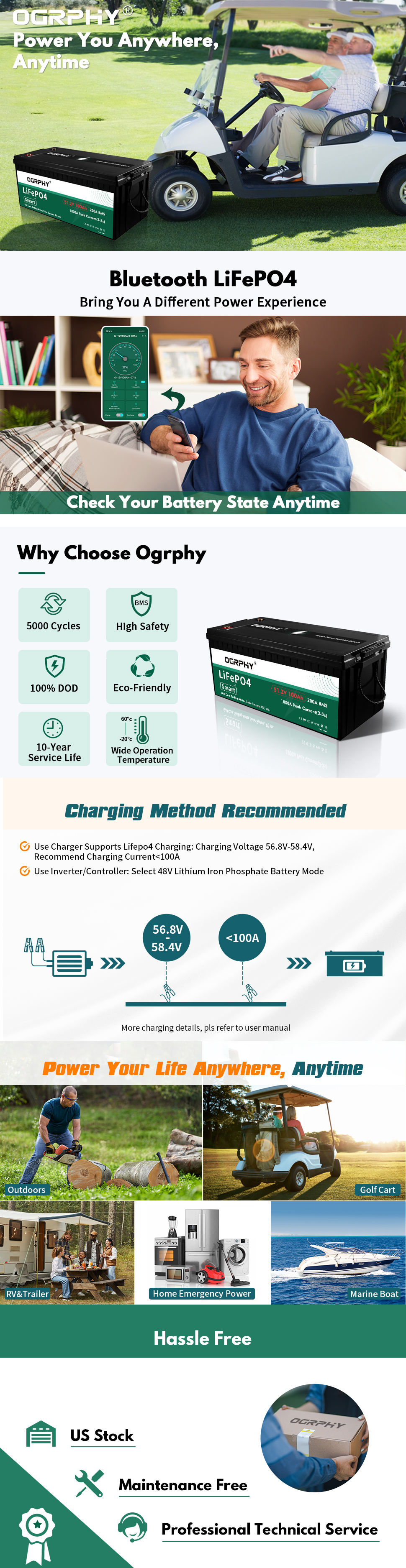
Charging. The 58.4V 18A unit included in the lithium golf cart batteries 48V conversion kit is built for this battery rather than adapted from an old lead-acid charger, and it connects with lugged leads and a standard AC cord. Plug it in at the end of the day and leave it: charge stops at 58.4V. A lower-current golf cart battery charger will still fill the pack, it just takes longer, so keep the supplied unit as your main charger and treat anything else as a backup. On the display. The LCD shows state of charge and the live numbers you actually use — pack voltage, current and temperature — and the charging indicator turns red while the pack is taking charge and green when it is full. Glancing at it before you set off beats judging by how the cart feels on the first slope. In the app. Download it from the product manual, switch on your phone's Bluetooth and connect. The screen shows pack voltage, current, power, temperature, individual cell voltages with the spread between them, and a cycle index. A weak cell or a hot connector shows up as a number instead of a mystery, and if the pack stops you can see which protection tripped before you start pulling fuses. Why owners keep it open. A lithium battery for golf cart use gets charged in a shed, a garage or a clubhouse with nobody watching, and reading the charge level from the seat saves a walk back to the cart.
Applications
- 48V golf carts. The main job — eighteen holes, the run back to the shed, a trailer of clubs or a groundskeeping load. The pack covers a normal day with margin left over.
- Trolling motors. A deep cycle trolling motor battery has to hold a steady draw for hours and be recharged the same evening; the 200A continuous rating sits comfortably above the sustained pull of most 48V motors.
- Solar and off-grid storage. A deep cycle lithium battery in a small 48V array takes charge from the controller and gives it back overnight, and the app lets you see how deep the overnight draw actually went rather than estimating it.
- RVs and campers. 5.12 kWh carries a night of fridge, lights and pumps for many setups. Check your own loads against that figure before you plan a trip around it.
- Boats and marine. House loads — electronics, lighting, a small fridge — with the protection board guarding against the deep discharge that quietly ruins a lead-acid bank.
- Backup and workshop power. As a 100Ah LiFePO4 battery it can sit as a 48V reserve for a shed, a gate or a pump, with the display showing its state at a glance when you need it.
- Current on tap when the motor asks for it. The management board is rated well beyond what a cart motor draws while cruising, so pulling away on grass, climbing a ramp or starting with a loaded trailer does not turn into a protection trip. - A tested range to plan a day around. In our own run a 3 kW cart motor covered 30 miles on a full pack. Terrain, load, tyre pressure and temperature all move that figure, but it gives you something to size a round against instead of a guess. - A pack you keep rather than replace. Deep-cycle lithium is counted in thousands of cycles rather than the few hundred a lead-acid bank manages before it fades, and there is no watering, no equalising charge and no terminal corrosion to chase between rounds. - State of charge without a multimeter. The LCD shows the live numbers and the app puts the same data on your phone, so checking the pack before a round is a glance rather than a test light and a torch. - One carton, everything included. Charger, display, wiring and terminal hardware arrive with the battery, so an install does not stall waiting for a part that was ordered separately. - Cells worth opening the case for. New grade A cells sit inside, matched to a board that keeps the pack delivering steady output as it ages instead of fading early.
Specifications
| Specification | Value |
|---|
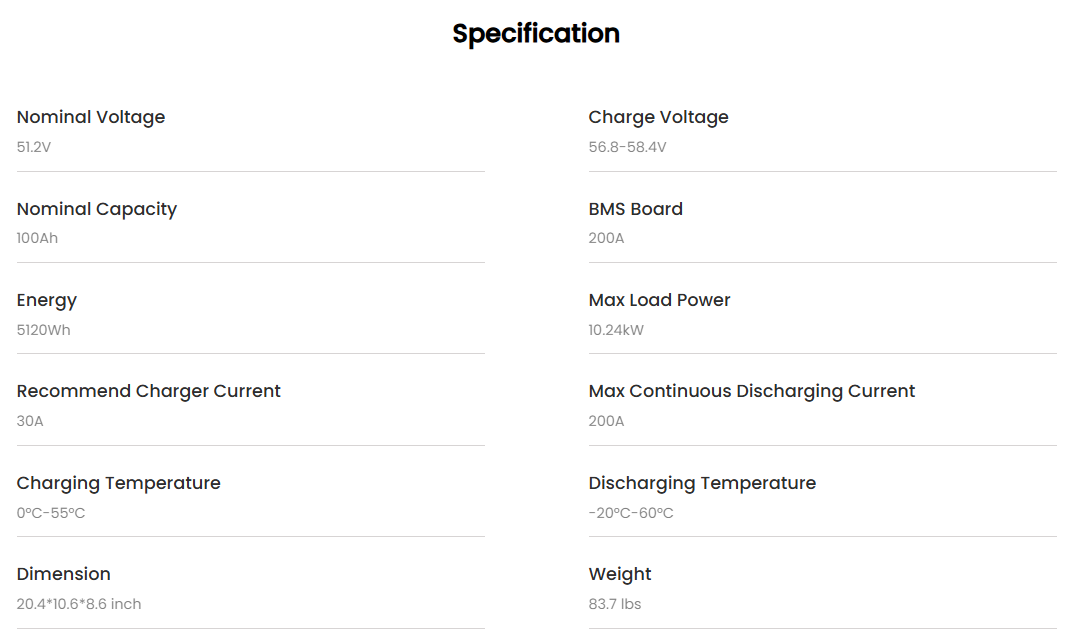
| Nominal voltage | 51.2V (48V system) |
| Nominal capacity | 100Ah |
| Stored energy | 5.12 kWh |
| Cell chemistry | LiFePO4, new grade A cells with UL certification |
| Battery management | Built-in smart 200A BMS |
| Continuous discharge current | 200A |
| Peak discharge current | 1000A for 3–5 seconds; 600A for about 30 seconds; 300A for about 32 seconds |
| Charge voltage | 58.4V |
| Charger supplied | 58.4V, 18A |
| Cycle life | 4000+ deep cycles |
| Monitoring | LCD display and Bluetooth app |
| Other suitable loads | Trolling motors (the pack works as a deep cycle trolling motor battery), solar systems, RVs, boats |
Choosing the Right Version
Voltage decides everything. A 36V cart needs one of the 36V packs — 100Ah, 102Ah, 105Ah or 150Ah — and a 48V cart needs this side of the range. Putting a 48V pack in a 36V cart is not an upgrade, it is a mistake, so check the controller plate or count the blocks and ask us if it is unclear. Capacity comes second. This pack is the 100Ah starting point of the 48V line; the 102Ah and 105Ah versions add a little reserve, and the 150Ah version is the one for long routes, hilly ground, heavy loads or a cart that runs several shifts between charges. When a full round plus the drive home is your normal day, the smaller pack is the cheaper way to get there. Ask before you commit. Send the cart model, the terrain and roughly how far a normal day runs. A 48V lithium golf cart battery that is too big costs money you did not need to spend, and one that is too small announces itself on the first long day.
Delivery, Warranty and Support
- Lead time. Stock orders are processed in 3–7 days. Custom builds take about 35 days, so confirm the details early if you are working to a date.
- Shipping. Stock is held in local warehouses and shipping takes 3–7 days from dispatch.
- Warranty. The pack carries a 5-year warranty.
- Checked before it is packed. Every lithium LiFePO4 battery is inspected and packed for transport before it leaves us. If the carton arrives damaged, photograph it before opening and contact us the same day.
- Matching the pack to the cart. Send your cart model, controller details and a photo of the battery bay if you are unsure. We would rather confirm that a 48V lithium golf cart battery suits your cart than process a return afterwards.
About Our Company
Xinyubattery is the brand of Shenzhenshi Xinyu Newenergy Technology Co.,LTD, a Shenzhen-based company founded in 2016 and working in green power solutions for more than ten years. Through a vetted network of production partners, we bring a broad range of power products together in one place and consolidate each order for you. Products are checked before dispatch, packed for export and shipped from local stock, and our team stays available for technical advice, fitting questions and after-sales help.
FAQ
How do I know whether my cart is 36V or 48V?
Count the blocks under the seat. Four 12V batteries or six 8V batteries make a 48V pack; three 12V batteries mean a 36V cart. The charger label and controller plate usually state the voltage as well. If the cart has been converted or rewired, send us the model and we will confirm before you order.
Can I fit it myself?
Most owners do. The lithium golf cart batteries 48V conversion kit is a straight swap: out with the lead-acid blocks, in with one case, then the main leads, the monitor and the charger. Allow an afternoon, photograph the old wiring before you disconnect it, and charge to full before the first drive.
Will it fit into my battery bay?
It is one case replacing several blocks, which usually leaves room to spare, but seat height is the measurement that catches people out. Measure length, width and the height to the underside of the seat, and send us the figures if the space is tight. Terminals sit on top, so leave clearance for the leads.
Do I still need my old charger?
No. The 58.4V 18A unit supplied with the pack is the right golf cart battery charger for it, and an old lead-acid charger should not be used because the finish voltage is different. Keep the supplied charger as your main unit; a lower-current charger will still work but takes longer.
What can I see in the app?
State of charge, pack voltage, current, power, temperature, individual cell voltages, the spread between cells and a cycle index. For a lithium battery for golf cart use that means you can check the charge level before a round, and see which protection tripped if the pack ever stops.
Can I use it for a trolling motor or a solar setup?
Yes. The pack handles the sustained draw of a deep cycle trolling motor battery and works as storage in a 48V solar system, and it also suits RVs and boats. Compare your motor or inverter rating against the 200A continuous figure and the 5.12 kWh of stored energy; if you are close to the limit, tell us the rating and we will check it.
Is 100Ah enough, or should I go bigger?
For a cart doing a normal round plus the drive home, yes. A 100Ah LiFePO4 battery at 48V stores 5.12 kWh, and our test ran a 3 kW cart for 30 miles on it. Step up to the 102Ah, 105Ah or 150Ah versions if your days are longer, the ground is hilly, you carry weight, or the cart works several shifts between charges.
How long will the pack last?
More than 4000 deep cycles, with a service life we expect to run past ten years in normal cart use. A deep cycle lithium battery does not sulfate the way lead-acid does, so sitting part-charged between rounds does far less harm. The 5-year warranty covers the pack itself.
What cells are inside the case?
New grade A cells assembled into a 51.2V pack and managed by the built-in 200A board. The lithium LiFePO4 battery chemistry is the reason the pack can be charged to full and left without the maintenance a lead-acid bank demands.