Product Overview
Swapping the lead-acid pack out for this 36V lithium golf cart battery is an afternoon's work, and the change is obvious the first time you pull away: the cart moves off cleanly and keeps its pace all the way round instead of fading over the back nine.
It arrives as a complete kit rather than a bare battery — a real lithium battery for golf cart conversions, with the charger, monitor and mounting parts already in the box, so nothing has to be sourced separately before the cart goes back into service.
In the photos the pack sits in Yamaha, EZGO and Club Car carts, the three makes most 36V courses run. It goes in at the same system voltage as the set it replaces, so the cart's existing motor and controller stay as they are. For a shop servicing a mix of carts that is one part covering most of the work; for an owner it is a golf cart lithium battery that drops in and gets on with the job.
Range & Capacity
- Up to 30 miles on a full charge. A complete pack carries a standard cart through a full 18 holes plus the run from the maintenance shed to the first tee and back to the clubhouse.
- One charge, one round. This lithium golf cart battery at 100% finishes a round without a top-up at the turn, so nobody is standing around waiting for a battery swap.
- What moves the number. Hills, four adult passengers, soft wet turf, low tyre pressure and a heavy foot all pull the figure down; flat, dry fairways with two players sit at the top of the range.
- Cold mornings and hot afternoons. Range is quoted in mild conditions, so a pack that sat in a freezing shed overnight gives a little less until it warms up — worth allowing for on a winter morning.
- Built as a deep cycle lithium battery. LiFePO4 is designed to be run down and recharged every single day, which is exactly what a course cart does, rather than only tolerating the occasional outing.
- Matching the pack to the route. A short nine-hole loop and a full day of running need different reserves; if your course is long, or the cart doubles as a utility vehicle in the afternoon, tell us the pattern and we will point you at the right capacity in the 36 volt golf cart batteries range.
Cycle Life Compared With Lead-Acid
| Spec | Lead-acid pack | LiFePO4 pack |
| Cycle life | 300–600 deep cycles | 4,000+ deep cycles |
| Capacity over time | Drops noticeably, often within two or three seasons | 80%+ retained across the rated cycle life |
| Voltage under load | Sags on climbs and with a full load | Holds a flatter, steadier curve |
| Weight in the cart | Heavy; the pack dominates the cart's weight | About 50% lighter |
| Routine upkeep | Watering, terminal cleaning, corrosion checks | Terminals kept clean and tight; no watering |
| Behaviour when idle | Degrades if left part-charged for weeks | No memory effect; charge whenever convenient |
| Replacement rhythm | A new set every few seasons | One pack rated for many thousands of rounds |
Specifications
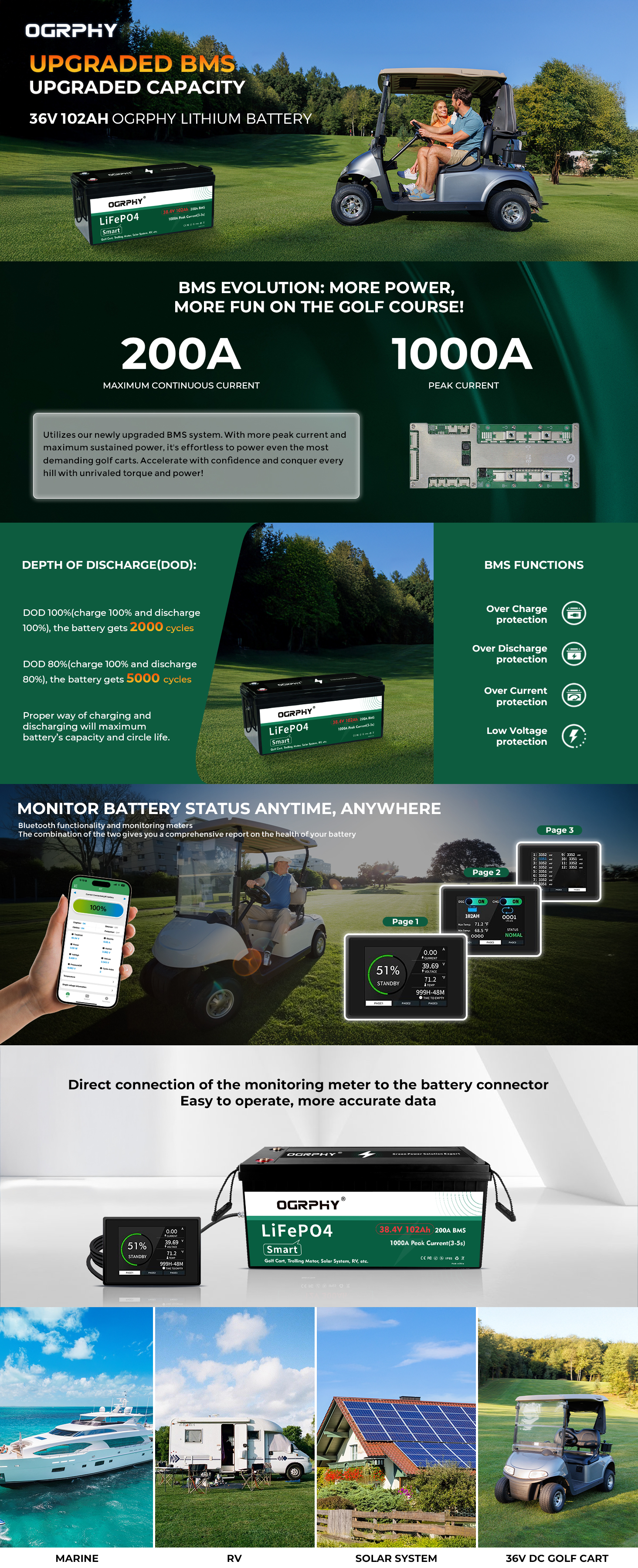
Peak current is the number that separates a pack that copes from one that cuts out mid-climb. The BMS in this 36V lithium golf cart battery holds 200 A continuously — enough for steady cruising with four players aboard — and releases up to 1,000 A for 3–5 seconds when the motor asks for everything at once. It will also carry 600 A for 30 seconds and 300 A for 32 seconds, the window that covers pulling away from a standing start, climbing a steep ramp out of a cart barn, or hauling a loaded utility trailer over wet grass. That headroom matters because the usual complaint after a lithium swap is not range, it is the sudden shut-off on a hill. Protection against overcharge, over-discharge, short circuit and over-temperature sits on the same board, and it keeps the output stable under heavy load instead of letting the voltage collapse. It also helps to know what the protection is doing when it acts. If a cell drifts, the pack runs hot, or the current climbs past the limit, the BMS intervenes and the reason is logged for the app — so a fault has a readable cause instead of a mystery dead cart. Anyone moving a fleet of electric golf cart batteries onto lithium will recognise that as the difference between a pack the crew trusts and one they quietly avoid.
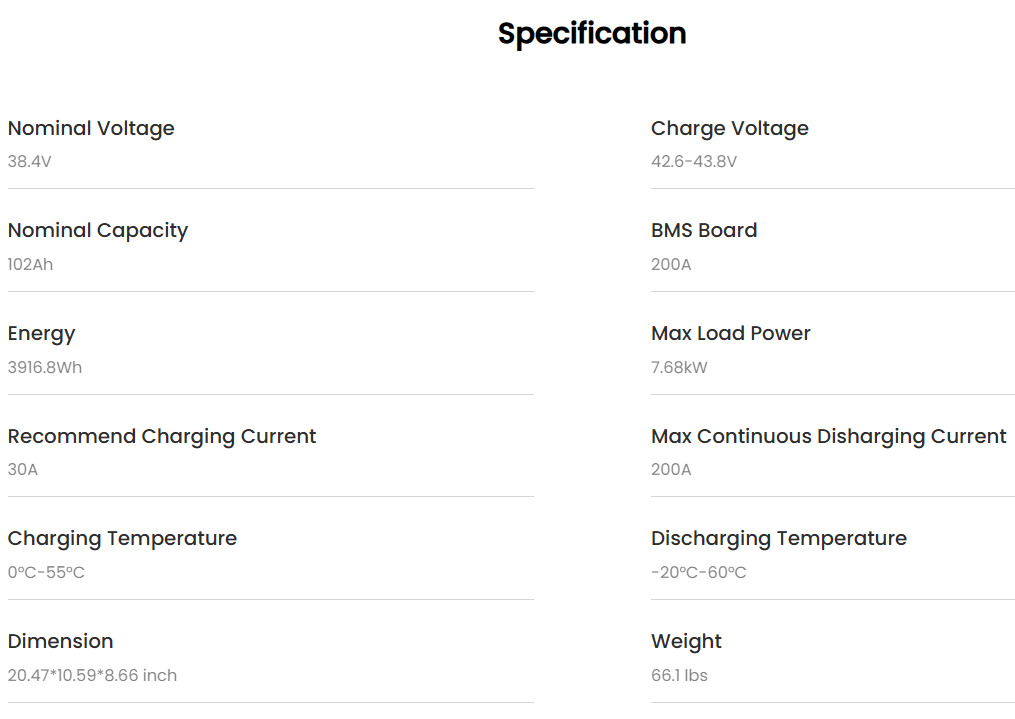
| Battery chemistry | LiFePO4 (lithium iron phosphate) |
| Nominal voltage | 36 V |
| Nominal capacity | 102 Ah |
| Stored energy | About 3.9 kWh |
| Continuous discharge current | 200 A |
| Peak discharge current | 1,000 A for 3–5 seconds |
| Boost current | 600 A for 30 seconds; 300 A for 32 seconds |
| Monitoring | Touch display plus Bluetooth mobile app |
| Included charger | 36 V 25 A lithium charger |
| Mounting hardware | Retention strap and monitor bracket included |
| Replaces | A 36 V lead-acid pack — this lithium battery for golf cart upgrade keeps the cart's original motor and controller |
Included Parts & Installation
- Unpack and check the box: battery, supplied charger, touch monitor and bracket, retention strap, terminal hardware and manual.
- Photograph the old wiring before you disconnect anything, then lift out the lead-acid set.
- Lower the new pack into the bay and tie it down with the heavy-duty strap — a lithium golf cart battery is light enough to shift in a hard turn if it is not secured.
- Reconnect the main leads to the top terminals and tighten them properly; a loose terminal is the most common reason a healthy pack seems to underperform.
- Bolt the monitor bracket in place, run the cable to the pack and clip the display in.
- Install the app, pair over Bluetooth and check that the pack reads the voltage you expect.
- Charge it to full with the supplied golf cart battery charger before the first round, then glance at the gauge before you set off.
Other 36V Equipment
- Bow-mount trolling motors. A 36V trolling motor on a bass boat or inshore skiff asks the pack for hours of steady thrust rather than a short run to the first tee. The 200 A continuous rating leaves headroom for a long day on the water, and the dash display shows what is left before the run back to the ramp. Send us the motor's full-thrust current draw and we will confirm the match.
- Groundskeeping and utility carts. Courses and estates run the same 36V chassis as guest carts, loaded with tools, sand or staff. The pack drops into the same bay and takes the same leads, but a bed full of equipment all morning draws noticeably more than a two-player round, so weigh the working load when you judge how much range you need.
- Resort, rental and shuttle fleets. An operator running a mixed line-up can keep one spare on the shelf: the same unit serves a guest cart, a maintenance buggy and a staff shuttle as long as each is a 36V system. Note the controller fitted to every cart before you move a pack between them.
- Low-speed vehicles on private roads. Neighbourhood carts, estate vehicles and site buggies wired for 36V take the kit without touching the motor or controller. They usually run shorter, flatter routes than a course loop, so one pack covers a day's use; measure the bay first if the vehicle was built around a different battery shape.
- Dealers and repair shops. If your counter handles carts, boats and buggies, one deep cycle lithium battery on the shelf covers more than golf work — the same pack that fits a fairway cart will turn a trolling motor or move a utility chassis. Check the equipment's continuous draw against the 200 A rating and the case against the bay, and ask us whenever a job sits outside either.
Touch Display & App Monitoring
- Touch display on the dash. The monitor mounts on its bracket and shows pack voltage, charging status and temperature in real time, so the state of charge is readable at a glance before a round.
- Bluetooth app on your phone. The same information goes to the mobile app, which is useful when the cart is in the barn and you want to check it without walking over.
- Cell-level detail. The app's parameter pages break the pack down into total voltage, current, average, high and low cell voltage and the spread between them, plus pack temperature and the cycle counter.
- Protection status in plain view. Charge and discharge switches, cell balancing and each protection flag show as on or off, so when something trips you can see which layer did it.
- Fewer wasted trips. A fault that would once have meant loading the cart onto a trailer can often be identified while it is still parked.
- A golf cart lithium battery that reports for itself. Because the history sits in the app, a dealer servicing several carts can check what happened between visits instead of guessing.
Charging & Storage Care
The charger supplied with the pack is matched to it, so there is no charge profile to guess at: connect it, let it finish, disconnect. Charging at 25 A takes several hours from empty, which makes it an overnight job or a between-shifts habit rather than something you stand and wait for.
Day-to-day care of a deep cycle lithium battery is routine rather than maintenance. Charge after use instead of leaving the pack flat for days, and if the cart stands for a long break, leave it part-charged and top it up before the season starts. Keep the case out of standing water, and let the pack come back to normal temperature before charging if it has been stored somewhere very cold or very hot.
A 36V lithium golf cart battery also tells you when something is off. If the display or the app raises a protection flag, note which one before you clear it — charge, discharge, temperature and short-circuit flags each point at a different cause, and knowing which one tripped saves a lot of guessing. If the same flag keeps coming back with the golf cart battery charger connected, stop and get in touch rather than working around it.
Ordering & Delivery
- Lead time. Stock orders are typically processed in 3–7 days, and custom builds run about 35 days.
- Shipping. Swift delivery from local stock, with 3–7 days for shipping once your order is dispatched.
- Warranty. Every pack is covered by a 5-year warranty.
- Dispatch point. Batteries are sent out from our US battery centre, which keeps repairs and exchanges straightforward.
- Support. Our team is reachable 24/7 for fitting questions, app setup and after-sales help.
- Before you order. Send the cart's make, model and year, plus the battery bay measurements if space is tight, and we will confirm the fit and the controller side of the install.
- Other packs in the range. If the cart runs 48 V, or you regularly cover longer distances between charges, the same golf cart lithium battery kit is offered in 48 V and in larger capacities for 36 volt golf cart batteries.
- Fleet and shop orders. Buying for several carts at once? Tell us the mix of electric golf cart batteries you need and we will put the whole order together.
About Our Company
Xinyubattery is the brand of Shenzhenshi Xinyu Newenergy Technology Co.,LTD, a Shenzhen-based company founded in 2016 and working in green power solutions for more than ten years. Through a vetted network of production partners, we bring a broad range of power products together in one place and consolidate each order for you. Products are checked before dispatch, packed for export and shipped from local stock, and our team stays available for technical advice, fitting questions and after-sales help.
FAQ
Will this battery fit my Yamaha, EZGO or Club Car?
If the cart runs a 36V system, very likely. The pack is built around the voltage and case size most 36 volt golf cart batteries use, and it is shown fitted to Yamaha, EZGO and Club Car models. Two things to check before ordering: the physical size of your battery bay, and that the controller is a standard 36V unit. Send us the make, model and year and we will confirm both.
Do I need to buy a charger separately?
No — a 36V 25 A golf cart battery charger is part of the kit, matched to the pack's charge profile, along with the touch monitor, bracket and retention strap. Your old lead-acid charger is not the right tool for a lithium pack, so it can retire with the old set.
Will it cut out on a steep hill with four passengers?
That is the scenario the 1,000 A peak rating exists for. The BMS holds 200 A continuously, then allows bursts of 1,000 A for 3–5 seconds, 600 A for 30 seconds and 300 A for 32 seconds, so a loaded lithium golf cart battery keeps pulling instead of tripping. If the cart has a larger aftermarket motor or a controller wound up for speed, tell us before ordering so we can check the current draw.
Is this lithium battery for golf cart use only?
Not at all. Light electric vehicles and small marine engines are the usual second home for this pack, which is why a shop can stock one part for several jobs. Check that the equipment runs a 36V system and that its continuous draw stays inside the 200 A rating; if you are unsure of the draw, give us the motor and controller details and we will confirm.
Do I have to run it flat before charging?
No. There is no memory effect to work around, so a top-up after nine holes or a partial charge between shifts does no harm at all. Flooded electric golf cart batteries are the opposite case — leave those sitting part-charged for weeks and they lose capacity, which is one reason owners find lithium less work.
Can it handle a daily routine, or does it need a rest?
It is built for daily duty. As a deep cycle lithium battery it is designed to be run down and recharged every day, so a course cart doing two rounds a day sits well inside its design. The cycle counter in the app lets you see how much of its rated life you have used.