Product Overview
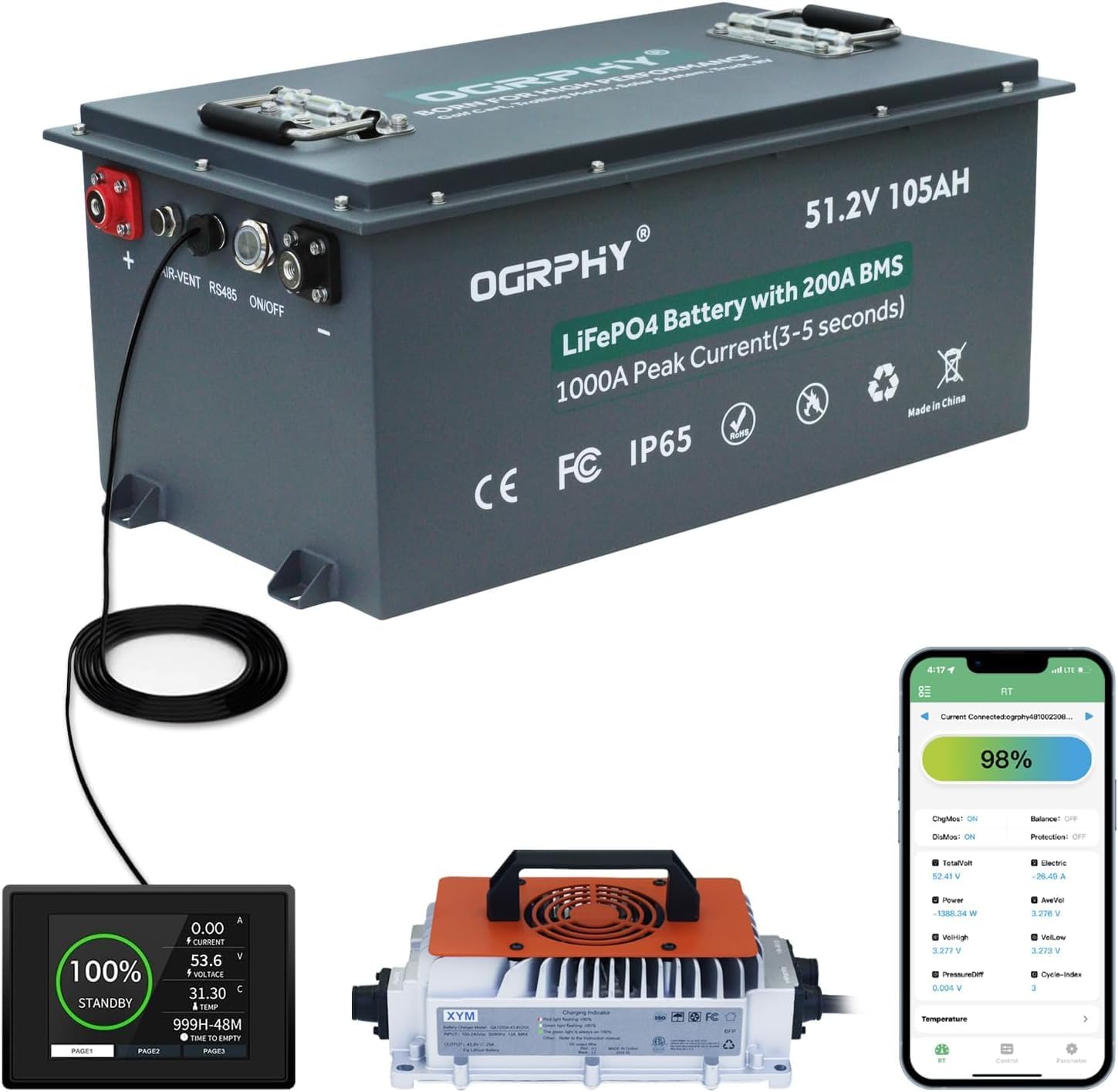
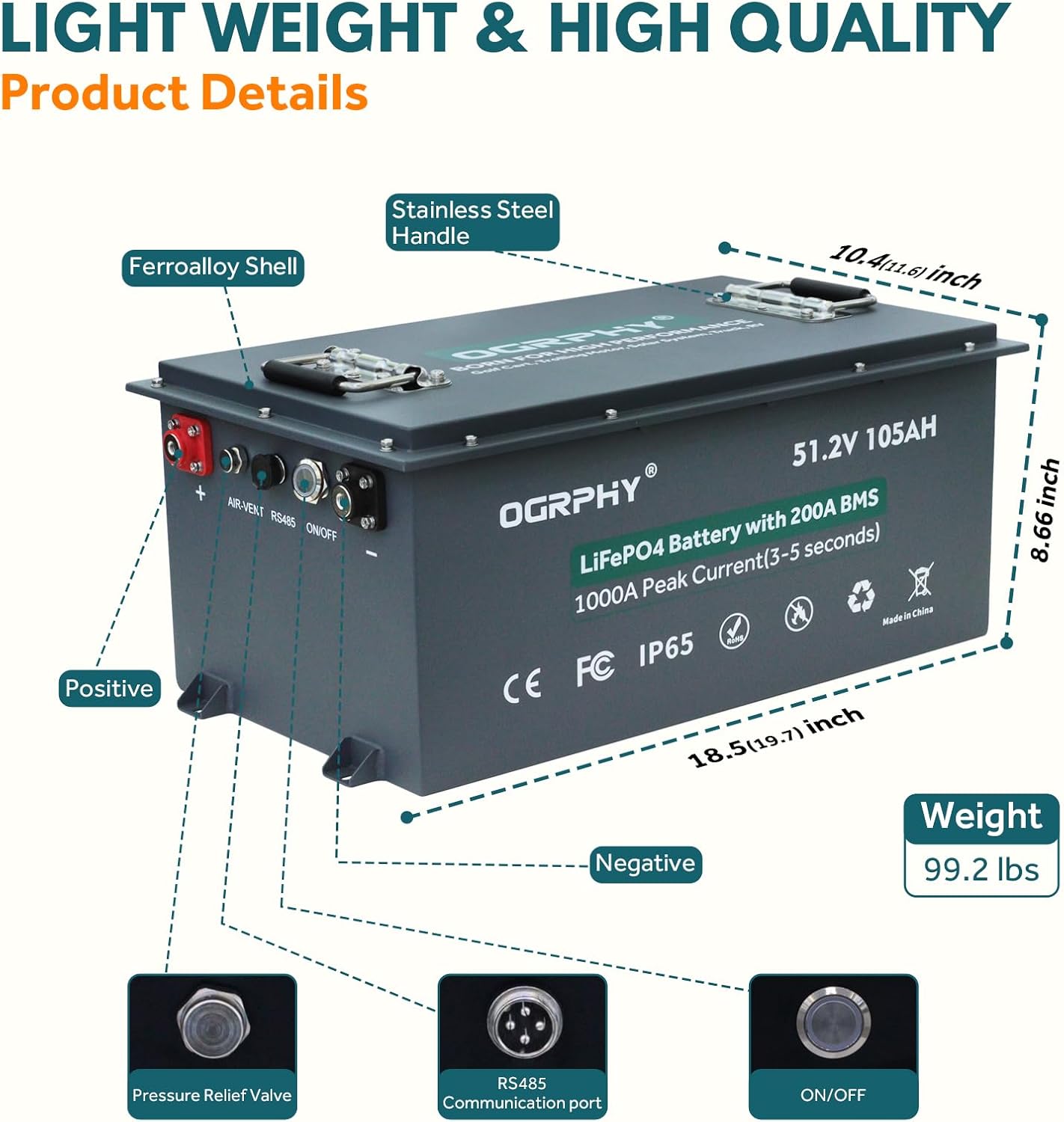
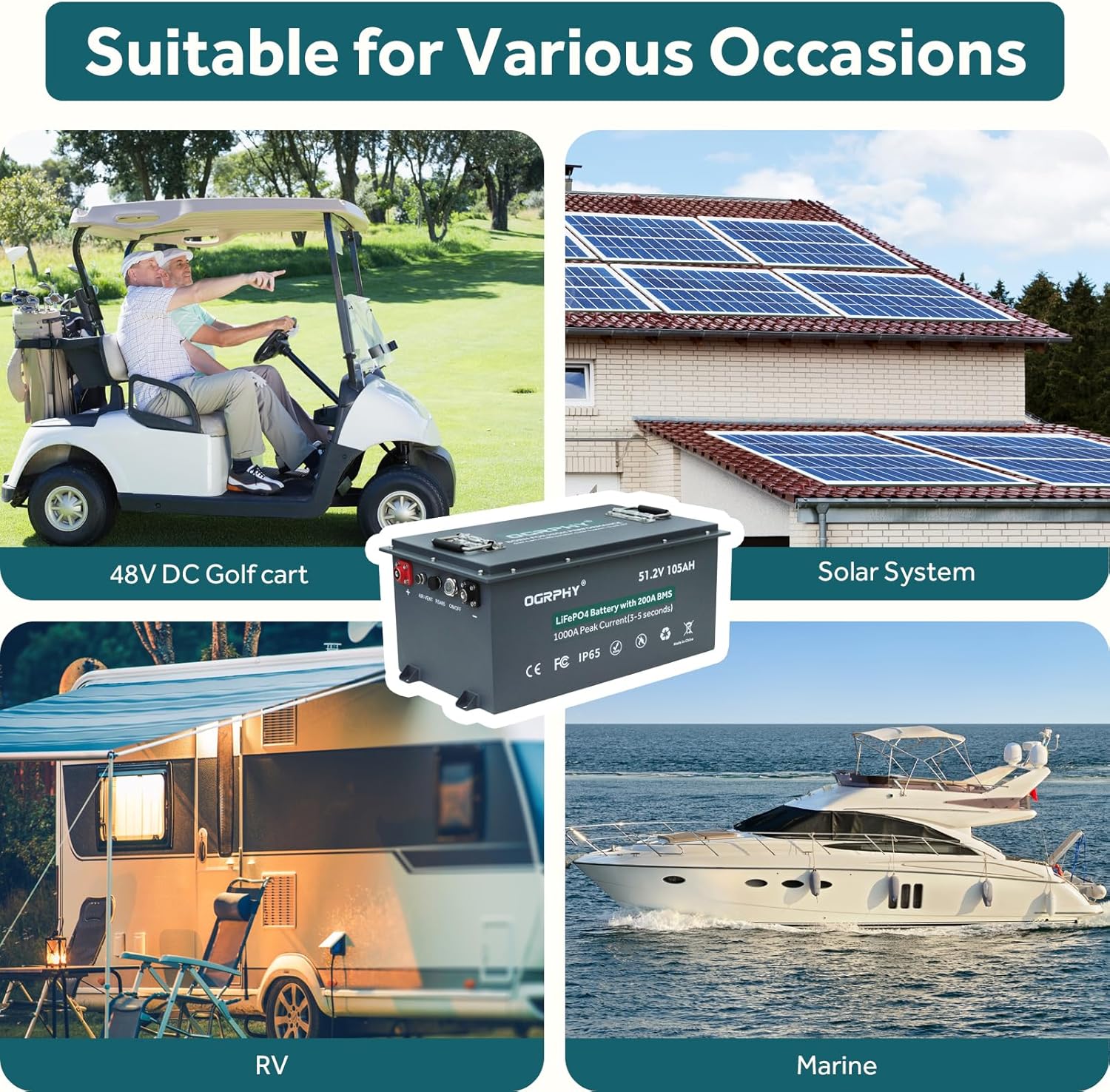
A cart's lead-acid set is a string of separate batteries to water, clean and eventually replace. This 48V lithium golf cart battery takes that whole string out of the equation: one sealed 51.2V LiFePO4 pack, 105Ah, in a grey metal case with stainless handles on top and the terminals and ports on the front face. The matched 18A charger and the LCD touch monitor travel with it, so the job is a battery change rather than a parts hunt. A normal week with it looks unremarkable in the most practical way. You drive, you plug in, you unplug in the morning. There is no water to top up, no equalising charge to remember and none of the terminal cleaning that flooded lead-acid asks for. The case is compact for its class, which matters more than it sounds. Older carts, and carts that were never designed around a lithium block, often have a bay that a bigger 48V pack will not enter. The pack was built against the controllers used on the major brands — Yamaha, EZ GO and Club Car among them — and the output stage is deliberately oversized so a loaded cart on a grade does not have to be nursed up the slope. It suits three settings in particular. A private cart that has just lost its second lead-acid set in five years and is tired of the routine. A course or maintenance fleet where a cart stopping mid-round costs more than the pack ever will. And a 48V off-grid bench, where the same unit doubles as storage and can be read from the house. If you are weighing up lithium golf cart batteries for the first time, two things decide the purchase: the bay measurements and the cart's voltage. Range, cycle count and monitoring follow from a pack that physically fits and electrically matches, and each of those is worth understanding before you buy. One boundary stated plainly: this is a deep-cycle traction pack for carts, solar storage and similar 48V loads. It is not a starter battery, and it is not the right part for a 36V cart or a 12V system.
Power Delivery & BMS
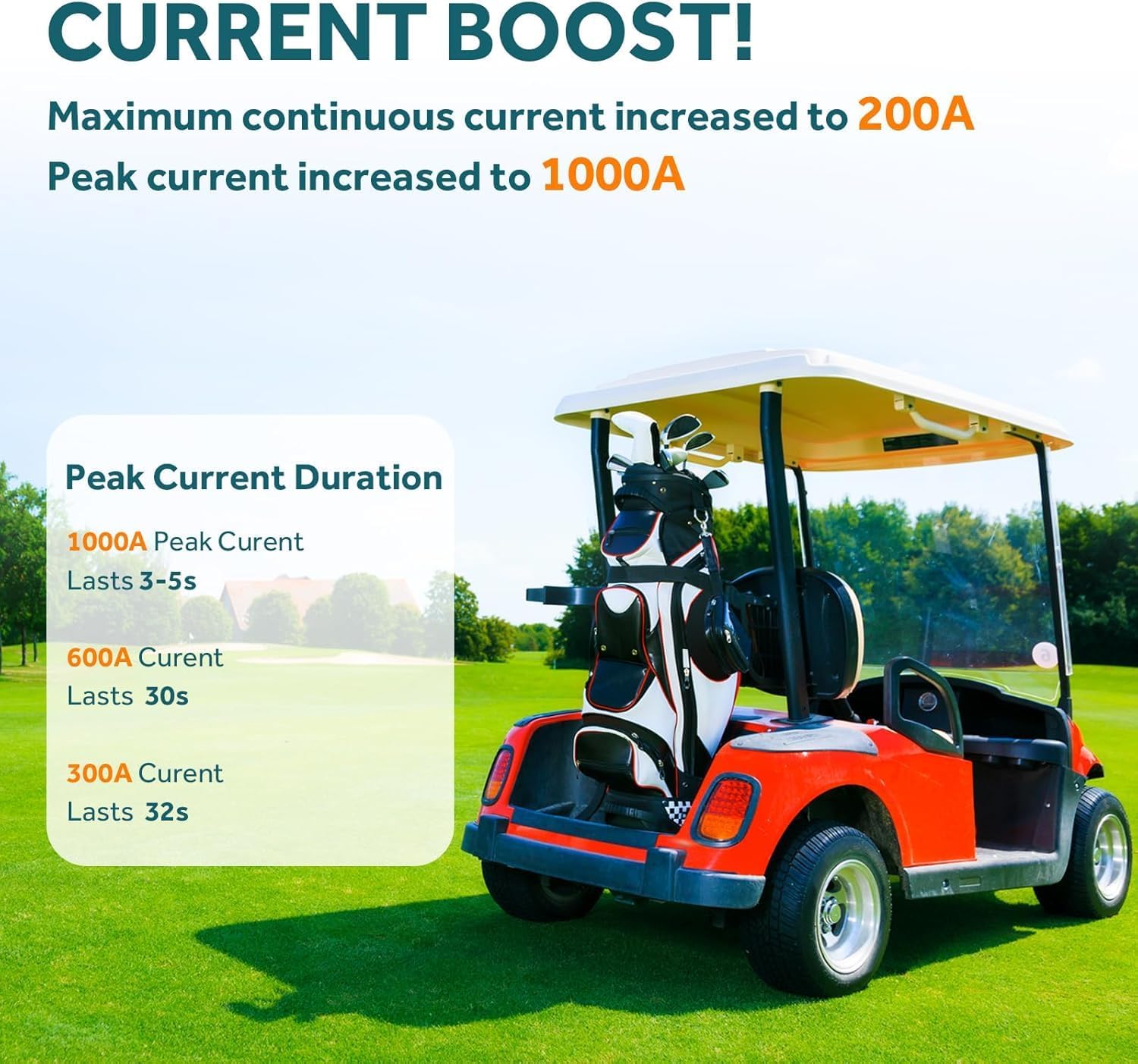
- 200A continuous is the number that decides a hill. The BMS holds it for as long as the cart keeps asking, which is what separates a pack that climbs steadily from one that feels like it is being rationed.
- 1000A for 3-5 seconds covers the surges. Pulling away, a wheel dropping into a rut or a loaded cart on a lip of concrete all send a short spike that a small BMS reads as a fault and shuts down on. Here the spike is absorbed and the cart keeps moving.
- The surge ladder continues past that first spike. Beyond 3-5 seconds the pack allows 600A for 30 seconds and 300A for 32 seconds, so a long climb tapers back gradually instead of cutting the cart dead halfway up.
- 10.24kW continuous and 51.2kW peak output. For 48 volt golf cart batteries in this class, that is generous headroom — enough that the controller, rather than the pack, becomes the limiting part of the drivetrain.
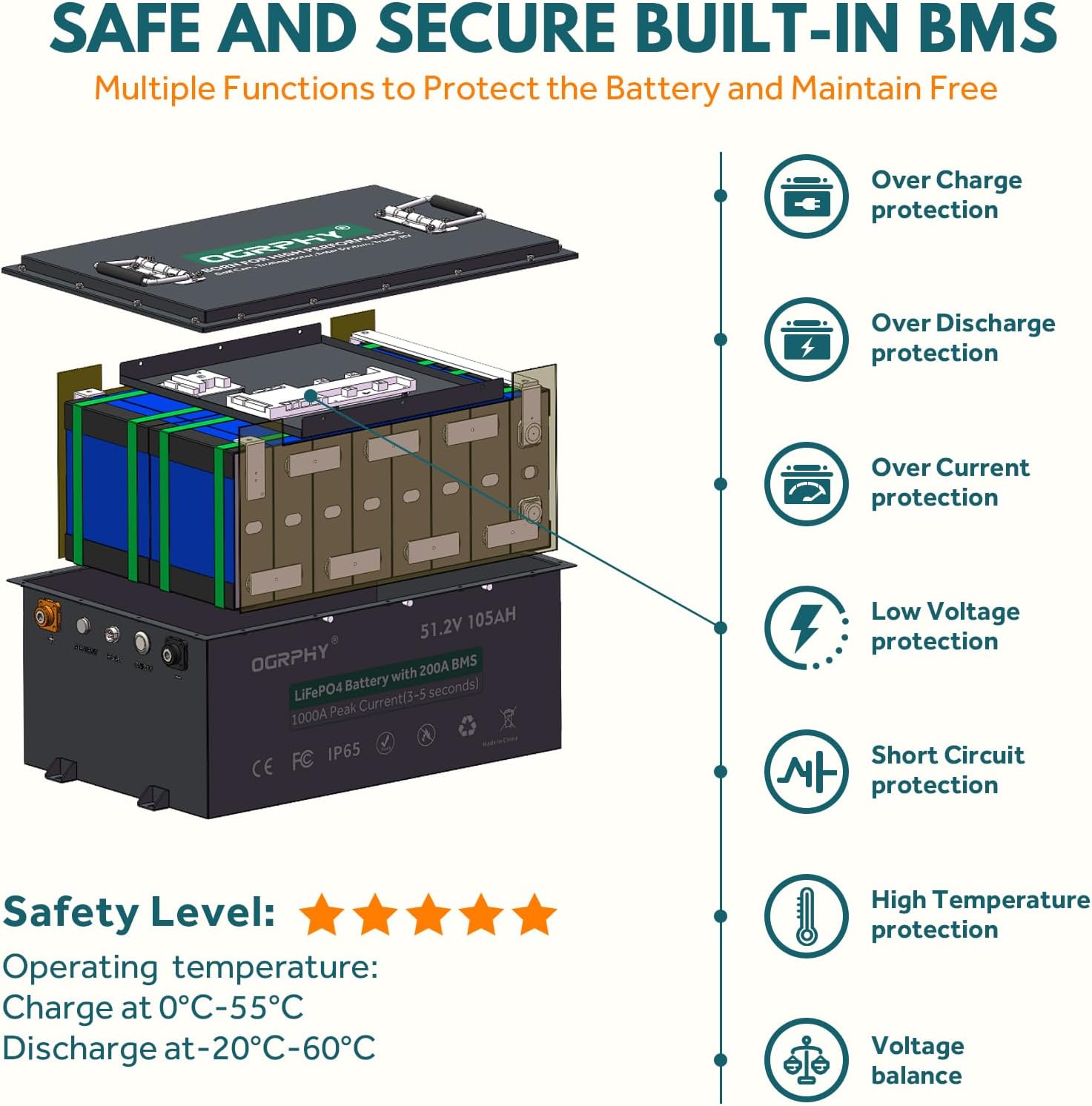
- Protection is built into the case, not bolted on afterwards. Over-charge, over-discharge, over-current, high and low temperature and short circuit are handled internally, and cell balancing runs on its own rather than through a manual routine.
- Grade A prismatic cells, UL certified, in a sealed metal enclosure. That specification is why this is a deep cycle lithium battery rated for traction duty rather than light cycling, and why it does not need to be treated gently between rounds.
Battery Bay Fit & Installation
- Confirm the voltage class first. A 48V cart runs six 8V or four 12V lead-acid units in series; if that is what sits under the seat, this pack is the right class. A 36V cart takes a 36V pack, not this one, and no amount of extra capacity makes the two interchangeable.
- Measure the tray, not the old batteries. Clear the old set out and measure the empty tray, then check the height under the seat as well as the floor area. 48 volt golf cart batteries of this class are close in footprint but not identical, and a couple of centimetres decides whether the seat closes and whether the monitor lead has somewhere to run.
- Plan the lift. At 99.2 pounds this lifepo4 lithium battery is a two-person job, and the stainless handles are there for exactly that. Lower it flat with the terminals to the front, where you can reach them, and keep fingers clear of the tray edges.
- Take the old set out safely. Disconnect the negative terminal of the old string first, then the positive, and lift the units out one at a time rather than dragging the whole set. Keep the interconnecting cables — most carts reuse them.
- Inspect the cart's cables before you reconnect. Clean the lugs, check that the ring terminals sit flat on the posts and that the insulation is not cracked or chafed. A frayed cable end should be replaced as a cable, not repaired at the lug, because it will heat under load.
- Route the monitor lead where it will survive. Keep it away from moving parts and sharp edges, mount the touch screen where the driver can see it from the seat, and leave enough slack that the pack can still slide out for service without stretching anything.
- Charge before the first round. Plug in the supplied 18A charger and let the pack reach full before the cart goes out. That first charge also confirms the monitor is reading voltage and current correctly, which is much easier to check on the driveway than on the 12th hole.
Range & Charging
Range starts with energy, and there is 5.37kWh in this pack. On a 3kW cart that works out at 50+ miles per charge, which in practice lands at 7-9 rounds of an 18-hole course before the pack needs a socket again.
Treat that as a planning figure rather than a promise. A lifted cart on oversized tyres, two passengers and a full bag, a course built into a hillside, or a cold morning will all pull the number down; a light cart on flat ground will beat it. What matters is the margin: 48 volt golf cart batteries at this capacity finish a round with something left rather than coasting in on the last bar.
Charging is deliberately unglamorous. The 51.2V 18A charger supplied with the pack is matched to its 105Ah capacity, so the pack is filled at a rate it was designed for. Plug in when you get back, unplug when you leave; there is no schedule to keep and no memory effect to manage. One practical note: 18A through a long, thin extension lead is a bad idea, so charge from a properly rated outlet at the bay.
If you are coming across from lead-acid, the habit that changes with a lithium battery for golf cart use is that topping up stops being a decision. A nine-hole evening followed by a top-up does not shorten the pack's life the way repeated partial charging does on a flooded set.
Off-grid, the same pack can be fed from a 48V solar array. That is a different charging path from the cart charger, so send us the array and charge-controller details before the first connection and we will confirm what the pack expects.
Monitoring & Diagnostics
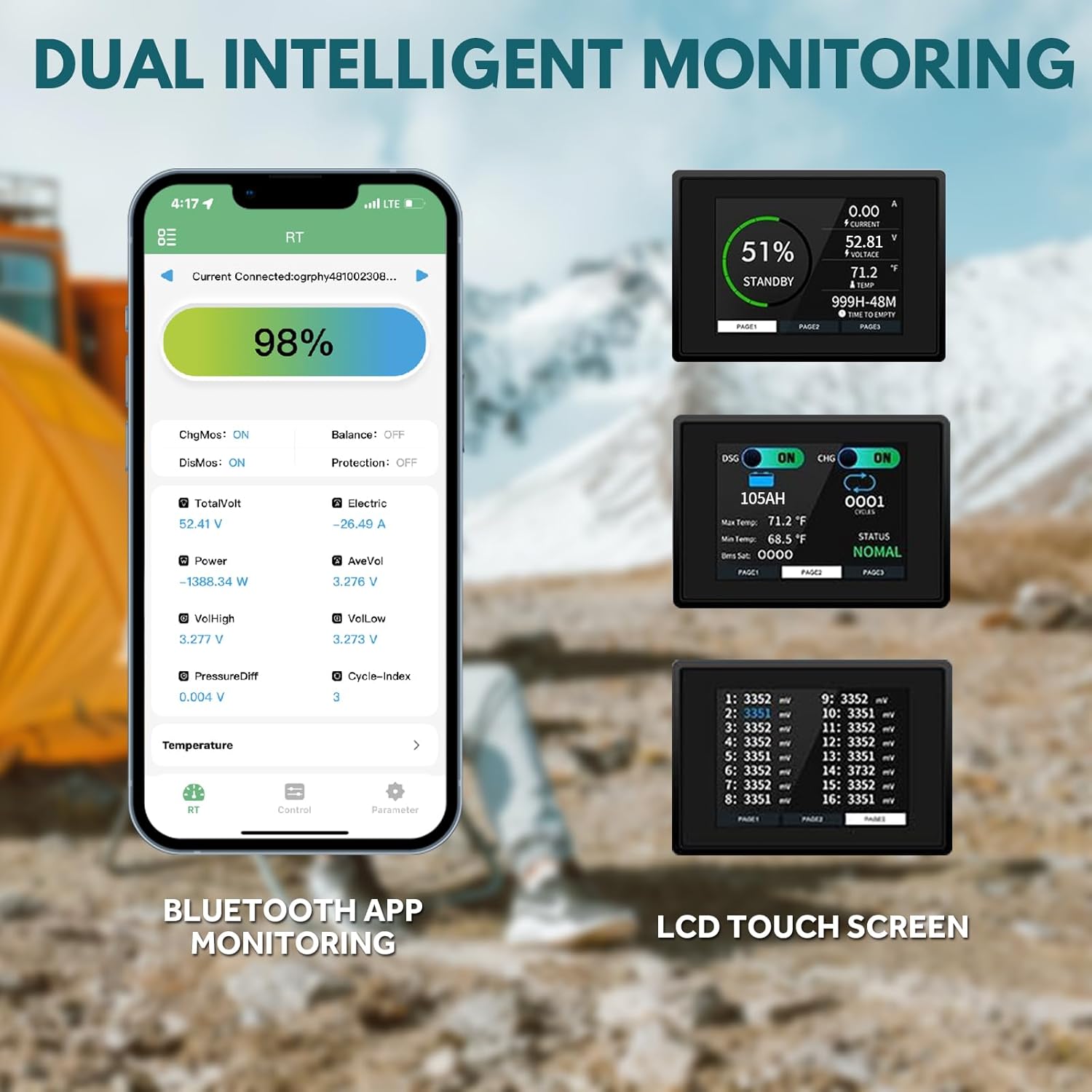
- Three screen pages on the pack itself. Voltage, current, temperature and time to empty sit alongside the status of the charge and discharge switches, so you read the pack under load instead of guessing from a bar gauge.
- The current figure shows direction as well as size. A negative reading means the cart is drawing, a positive one means it is charging — which makes a stalled cart much easier to reason about.
- The phone app carries the same information at a distance. State of charge, current, power and the charge, discharge, balance and protection flags are all readable from the driver's seat or from the workshop bench.
- Fault-finding happens before dismantling. If a cart stops, read the screen first: a protection flag points at over-temperature, over-current or a voltage problem before anyone lifts the pack out of the bay.
- This is what makes a lifepo4 lithium battery diagnosable rather than mysterious. Most lithium conversions fail in the owner's confidence long before they fail electrically, and a readable status screen fixes that.
- For a course or maintenance fleet running 48V golf cart batteries, it changes the morning routine. One walk down the line reading state of charge turns a deep cycle lithium battery from a black box into something a supervisor can check in seconds.
- Glance before you load the clubs. It is a two-second habit that removes the most common cause of a cart dying on the back nine.
Cycle Life & Lead-Acid Replacement
| Comparison | Detail |
| Cell chemistry | LiFePO4, grade A prismatic |
| Deep cycles to 80% DOD | 4000+ |
| Cycle life of the lead-acid set it replaces | 300-600 cycles |
| Longevity versus lead-acid | Roughly 10 times the cycle count |
| Lead-acid bank replaced | 8 x 12V 100Ah |
| Watering and equalising | Not required |
| Weight versus the lead-acid set | Considerably lighter |
| Depth of discharge | Rated at 80% DOD |
Specifications
| Specification | Details |
|---|
| Voltage | 51.2V(DC) |
| Capacity | 105Ah |
| Energy | 5.37kWh |
| BMS | 200A(continuous) |
| Peak current | 1000A(3-5s) |
| Cycle life | 4000+ deep cycles(80% DOD) |
| Weight | 99.2 Pounds |
| Dimensions | 11.6"D x 19.7"W x 8.66"H |
| Internal resistance | 15 milliohms |
| Monitoring | LCD touch monitor + mobile APP |
| Charger | 51.2V 18A |
| Compatibility | 48V golf carts,solar systems |
| Operating temperature | Charge: 0 °C-55 °C; discharge: -20 °C-60 °C |
| Warranty | 5 years |
Ordering, Delivery & Warranty
- Confirm the fit before you order. If the bay is tight or the cart is an unusual model, send us the cart model and the tray measurements and we will check them against the case for you. A return on a pack this heavy is nobody's idea of a good week.
- Confirm the voltage class. 48V golf cart batteries are not interchangeable with 36V ones, and the wrong voltage class is the most common ordering mistake we see.
- Dispatch. In-stock lithium golf cart batteries leave the warehouse in 3-7 days. Customised builds take about 35 days, so tell us early if the cart is needed for a season start.
- Delivery. Swift Delivery, with stock in the local warehouse — 3-7 days for shipping. Heavy packs are sometimes split across more than one parcel by the carrier, so a second tracking number is normal rather than a problem.
- Warranty. The pack carries a 5-year Warranty. Keep your order details together with the monitor's lead, and if a fault appears, note what the status screen shows — that is the fastest way for our support team to work out what happened.
About Our Company
Xinyubattery is the brand of Shenzhenshi Xinyu Newenergy Technology Co.,LTD, a Shenzhen-based company founded in 2016 and working in green power solutions for more than ten years. Through a vetted network of production partners, we bring a broad range of power products together in one place and consolidate each order for you. Products are checked before dispatch, packed for export and shipped from local stock, and our team stays available for technical advice, fitting questions and after-sales help.
FAQ
Will this 48V lithium golf cart battery work with my cart's controller?
If your cart is a 48V machine, yes. The pack was built against the controllers used on the major brands — Yamaha, EZ GO and Club Car among them — and it presents itself as a 51.2V pack, which is what a 48V controller expects. Two things are worth checking before ordering: that the cart is 48V rather than 36V, and that the cables and lugs are in good condition. If the cart has been modified or runs an unusual controller, tell us the model and we will look at it with you.
How many rounds will 48V golf cart batteries of this size cover on one charge?
On a 3kW cart the pack is rated for 50+ miles, which typically comes out at 7-9 rounds of an 18-hole course. That assumes a standard cart, moderate load and mixed terrain. Lifted carts, large tyres, steep courses and cold mornings all reduce it, so plan around the 50-mile figure and keep the habit of charging after each round rather than running the pack down.
If it runs at 200A, why does this golf cart lithium battery need 1000A peak?
Because the controller does not ask for a steady current. Pulling away, climbing a kerb or loading a wheel sends a short surge that a 200A-only pack would treat as a fault and shut down on. The BMS rides that surge at up to 1000A for 3-5 seconds, then steps down to 600A for 30 seconds and 300A for 32 seconds, so a long climb tapers instead of stopping the cart.
Do I need a new charger when I change to lithium golf cart batteries?
Yes — use the 51.2V 18A charger that ships with the pack. A lead-acid charger is built around a different charge profile and is not suitable for this battery. The 18A output is matched to the 105Ah capacity, which is what lets the pack fill properly rather than quickly.
Can I keep using a lithium battery for golf cart in cold weather?
Discharging is fine from -20 °C to 60 °C, so winter driving is not the problem. Charging is the part to watch: the charge window starts at 0 °C, so let a cold pack come up to temperature before you plug it in rather than charging straight off a frosty trailer.
Is this lifepo4 lithium battery safe to leave in the cart between rounds?
Yes. The cells are sealed, the BMS covers over-charge, over-discharge, over-current, high and low temperature and short circuit, and there is no water to add and no acid mist to manage the way there is with a flooded set. Park it, plug it in if you have power at the bay, and leave it — just keep it inside the stated charge and discharge temperature windows.
Can this deep cycle lithium battery be used for solar storage as well as a cart?
It is specified for 48V golf carts and solar systems, so a 48V off-grid array can charge it. Solar charging is a different job from a cart charger, though, so send us the array size and the charge-controller details before you wire it in and we will confirm the settings the pack wants.
What comes in the box with a golf cart lithium battery order?
The pack ships with the 51.2V 18A charger and the LCD touch monitor with its lead. The stainless handles and front terminals are part of the case, so there is nothing else to buy to get the cart running. If you are replacing a lead-acid set, the cart's existing cables and lugs are usually reusable — but inspect them before you reconnect, because a worn cable will heat under load. A lithium battery for golf cart use does not need a separate fuse box or external shunt to work with the supplied monitor.