Product Overview
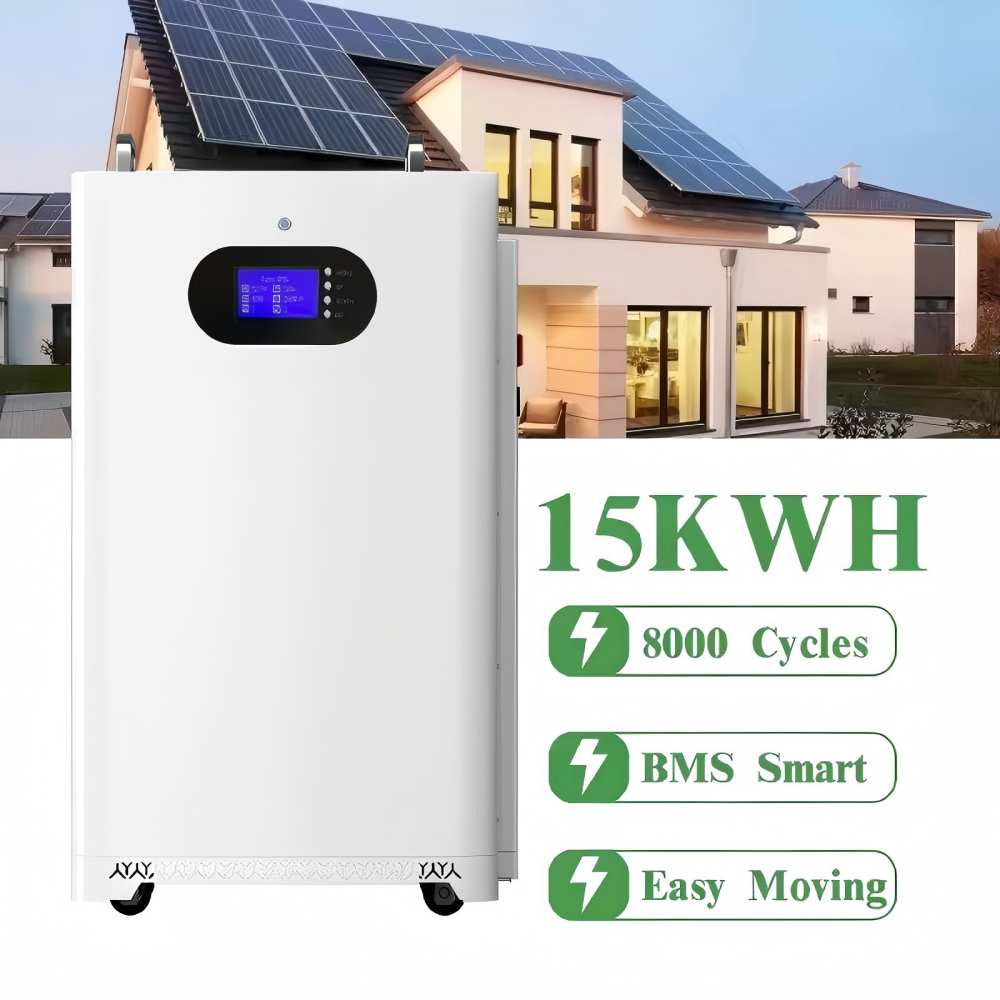
This is a floor-standing home battery: a white cabinet on casters, a display panel across the front, and 15.36 kWh of LiFePO4 storage inside. At 51.2 V nominal and 300 Ah, it is sized for the work a house actually asks of a battery — carrying the fridge, lights, router and a handful of sockets through an outage, and soaking up surplus solar during the day so the same energy is still there after dark.
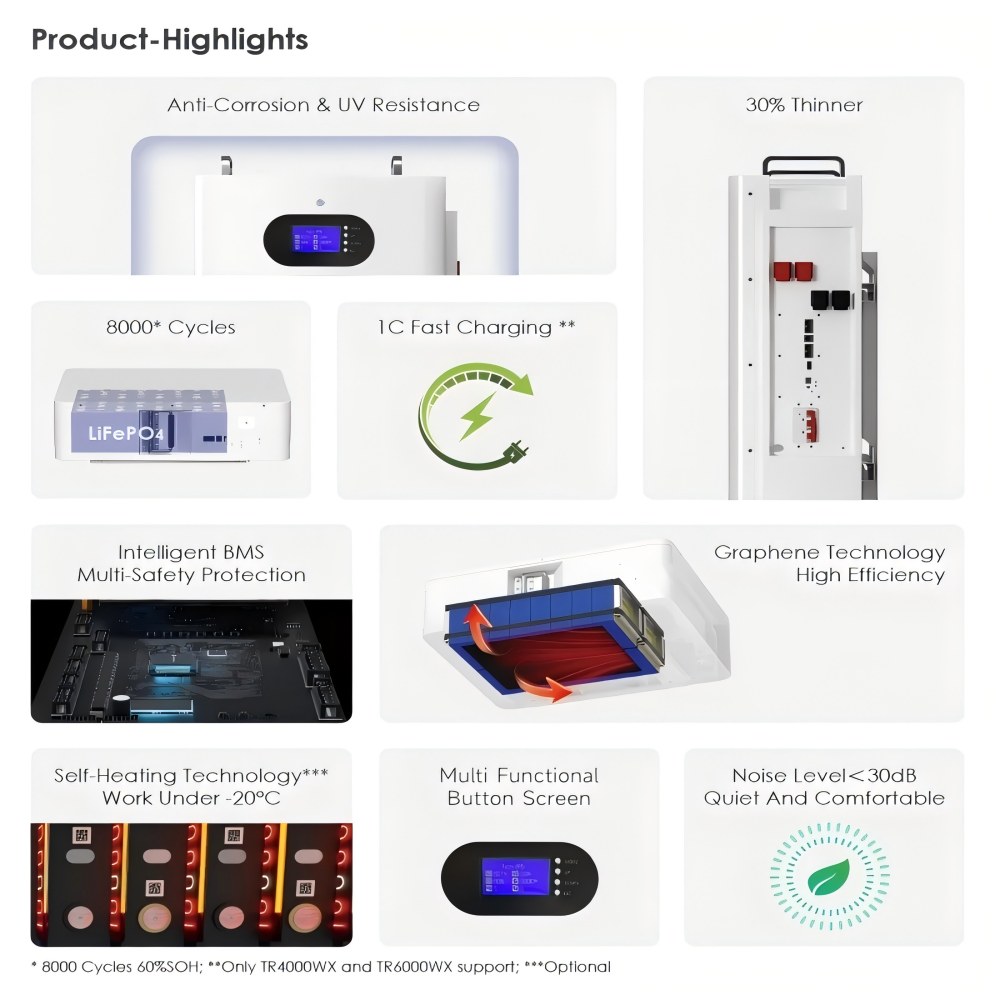
Inside the cabinet, an active balancer holds the cell groups at matching voltage while the pack charges and discharges. That is what keeps a lithium deep cycle battery behaving like new after years of daily cycling, instead of drifting out of balance and cutting off early. A built-in battery management system watches voltage, current and temperature, and the front display puts those readings where you can see them without reaching for a phone.
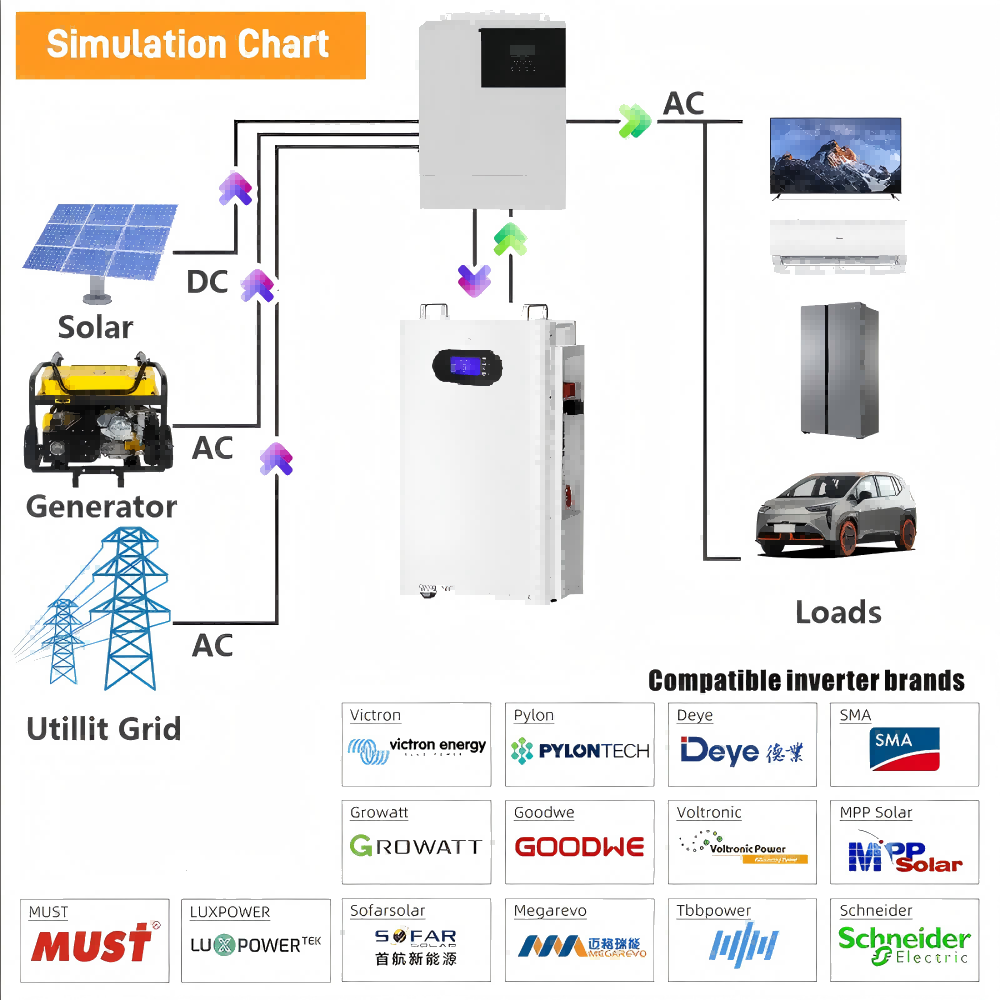
Three charging paths run through the system: the utility grid, a generator, and a solar array via the inverter. On a grid-tie house the pack fills from PV during the day and from the mains overnight; on an off-grid site the array does most of the work and the generator covers the dark weeks.
It is an indoor floor-standing unit rather than a wall-hung box, which suits plant rooms, garages and utility corners where a shelf of lead-acid blocks used to sit. The DC side lives in the cabinet; the inverter, changeover and house wiring stay outside it and are chosen to match your loads.
- Serious capacity in one footprint. 15.36 kWh at 51.2 V and 300 Ah means a single cabinet covers a realistic backup circuit list, instead of three or four smaller packs wired together in a corner. - Balancing that keeps working. Cell groups are levelled during charge and discharge, so usable capacity does not quietly shrink as the pack ages. - A LiFePO4 lithium battery in its most forgiving form. Iron-phosphate chemistry takes daily partial charging in its stride and does not need the full-charge discipline that lead-acid demands. - Almost no idle drain. Standby consumption stays below 1 W, so a pack left connected over a quiet week is still where you left it. - A shelf of deep cycle batteries, replaced by one cabinet. The format takes over from a row of heavy blocks without asking for a bigger room or a watering routine. - Parallel-ready from day one. A second, fifth or sixteenth unit joins the bank when your loads grow, up to the stated 240 kWh ceiling. - Readable without an app. The front display shows what the pack is doing at a glance, which matters most on the day something is not behaving.
Battery Management & Safety
The battery management system is the part you never see and would notice immediately if it went missing. It tracks pack and cell voltages, current and temperature, and it opens the circuit when any of them leaves the safe window: overcharge at the top, over-discharge at the bottom, over-current under a heavy load, and high or low temperature at either end. Thermal management runs alongside it, so the pack is not asked to work in conditions it was not built for.
Balancing is the quieter job. The active balancer moves charge between cell groups while the pack works, keeping them level. Without it, a lithium deep cycle battery drifts: one group reaches the top first, the BMS stops the charge early, and the capacity you paid for slowly becomes capacity you cannot use. Keeping the groups level is what lets the pack keep delivering close to its rated 15.36 kWh over a long service life.
On the compliance side, this model is listed against UN38.3 for transport, IEC62619 for stationary storage safety, and RoHS for restricted materials — the documents a carrier, an electrician or an insurer is most likely to ask for. Ask us for the current copies if your installer needs them for the file.
What the BMS is not is a substitute for siting. It protects the cells from electrical abuse; it will not ventilate a sealed cupboard or keep water out of a cellar corner. Give the cabinet a dry, airy position, keep the vents clear, and the electronics only have to do the job they were designed for.
Three Charging Paths
- Utility grid. The usual route on a grid-tie house. The inverter charges from the mains overnight, or tops the pack up when a storm warning lands.
- Generator. For off-grid sites and long outages. The generator feeds the inverter or charger, which then charges the battery at whatever rate the two are configured for.
- Solar array. The day-to-day source. PV runs through the inverter or an MPPT charger into the pack, so surplus production is stored rather than exported and bought back later.
- Priority settings decide the order. Most inverters let you choose solar-first, grid-first or generator-first. Set that before commissioning so the battery behaves the way your tariff and your fuel budget expect.
- A battery storage power station still needs a charger in front of it. The cabinet stores and delivers DC power; the inverter or charger is the part that turns grid, generator or PV current into something the pack can absorb, and it is chosen around your loads.
Installation & Siting
- Roll it in before wiring. The cabinet sits on casters, so measure door widths, thresholds, steps and turning space along the route to the plant room before delivery day.
- Level, dry and ventilated. A utility room, garage or purpose-built plant corner works. A floor that floods, or a cupboard with no air movement, does not.
- Give the front panel and vents room to breathe. The display is on the front face and the cabinet needs airflow around it — confirm footprint, weight and clearance with us before you build a plinth or a surround.
- Keep it near the inverter. Short DC runs and a nearby breaker or isolator make service easier and reduce losses.
- Watch the room temperature. The rated operating window is −20 °C to 65 °C, but a cabinet in direct summer sun or beside a boiler flue is working harder than it needs to all year round.
- Clear the old bank first. If it is replacing a rack of deep cycle batteries, remove the rack, shelf and old cabling before the new cabinet arrives so it has a clean position and a clean earth.
Typical Applications
- Grid-tie homes with backup circuits. The pack stores daytime solar for the evening and holds selected circuits when the grid drops. A lifepo4 lithium battery handles that daily shallow cycling comfortably.
- Off-grid cabins and tiny houses. Paired with an inverter/charger and a generator for the dark weeks, one cabinet covers lighting, refrigeration, a pressure pump and device charging.
- Small commercial backup. A workshop, farm office, clinic or shop counter that cannot afford a cold restart — the cabinet keeps the till, the freezer, the network gear and the security system running.
- Installers building modular banks. A deep cycle lithium battery that parallels cleanly lets you quote a 15 kWh start and a 60 kWh finish from the same hardware and the same commissioning routine.
- Replacing an ageing lead-acid room. Where a shelf of flooded blocks and a watering rota used to live, one sealed cabinet and a front display take over, with the floor space handed back.
Specifications
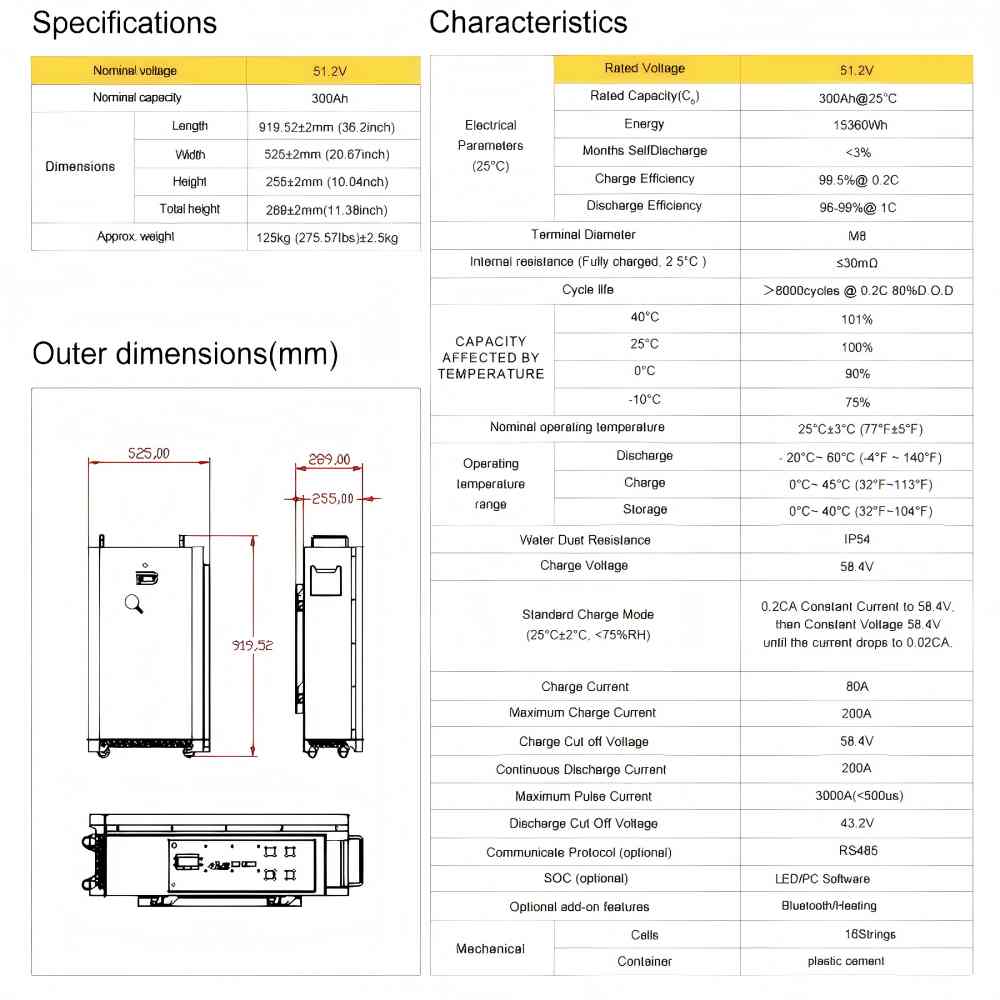
| Nominal voltage | 51.2 V |
| Nominal capacity | 300 Ah |
| Total energy | 15.36 kWh |
| Battery chemistry | LiFePO4 |
| Cycle life | Up to 8,000 cycles at 0.2C, 25 °C, 80% depth of discharge |
| Standby consumption | Below 1 W |
| Operating temperature | −20 °C to 65 °C |
| Design service life | 10 years |
| Parallel capability | Up to 16 units, 4,800 Ah / 240 kWh maximum |
| Charging sources | Utility grid, generator, solar array |
| Monitoring | Built-in BMS with front LCD display |
| Listed standards | UN38.3, IEC62619, RoHS |
| Form factor | Floor-standing cabinet on casters |
Sizing Your Backup Load
Nameplate energy is the starting point, not the answer. The 15.36 kWh on the label is what the pack holds; what you can draw from it depends on how far down you take it, how efficient the inverter is, and how cold the room gets. A 48v lifepo4 battery like this one normally runs between a full charge and a floor set in the inverter, and the round trip through the inverter costs a slice of every kilowatt-hour in both directions.
The practical way to size it is to write a load list. Take the circuits you want to keep alive — fridge, freezer, lights, router, boiler controls, a few sockets — note the watts printed on each appliance, multiply by the hours you would run them during an outage, and add up the totals. Leave a margin rather than sizing to the last watt-hour, because motors and compressors pull a surge on start-up that the pack has to supply for a second or two while the running load looks small.
Then check the surge side against the inverter, not just the stored energy. A well pump or a fridge compressor can demand several times its running current the moment it starts, and the inverter has to be able to deliver that from the battery. If the numbers feel tight, the same series runs in smaller 5 kWh and larger 16 kWh versions, so the cabinet can follow the load rather than the other way round.
Send us the finished load list together with your inverter model and we will tell you whether this unit is the right size, or whether you should step up or down.
Day-to-Day Operation
Day to day, the cabinet asks very little. The front display shows state of charge, voltage, current and temperature, and a glance once a week tells you whether the pack is behaving. If your inverter has an app or a portal, that is where charge windows and reserve levels are set — the battery is the storage, not the control panel for the whole system.
Keep a simple routine. Before a forecast storm, check the state of charge and top up if the sun has been poor. Once a month, look at the display for alarm messages and wipe the dust off the vents; a cabinet that cannot breathe runs warmer than it should. If the property will be empty for the season, store the pack charged rather than flat and check it when you return.
Faults are usually readable before they become failures. Note the code or message on the screen, photograph it, and send it to us with the inverter's own log — the two together almost always point at the cause. The pack also protects itself: an over-temperature or over-current event shuts the output down rather than pushing through, and it comes back once conditions are inside the window again.
As a battery storage power station for a house, its job is to be boring. No watering, no equalise charge, no terminal cleaning — just airflow, a sensible room temperature and an occasional look at the display.
Ordering & Delivery
- Lead time. Stock orders are despatched in 3-7 days; custom builds take 35 days.
- Shipping. Swift delivery from local stock, with 3-7 days in transit once the unit leaves the warehouse.
- Warranty. Every unit carries a 5-year warranty.
- Send the system details first. Inverter make and model, single or three-phase, the load list, and whether the site is grid-tie or off-grid — that is what lets us confirm the unit and the settings before it ships.
- Tell us about the delivery route. Door widths, stairs, lift access and whether there is a loading dock at the address; a floor-standing cabinet on casters still needs a way in.
- Building a bank. Order the cabinets together so they arrive matched and can be commissioned as one bank rather than added piecemeal.
- 1. Decide the target bank size first. Each cabinet adds 15.36 kWh and up to 16 units can be paralleled for a maximum of 4,800 Ah / 240 kWh, so work out where you want to stop before ordering the second unit.
- Keep the units identical. A 48v lifepo4 battery bank is only as well matched as its weakest member, so add the same model rather than mixing capacities or ages.
- Plan the DC side with your installer. Busbars, breakers, fuse ratings and cable lengths all change when another cabinet joins, and equal cable lengths across the bank are what keep the units sharing current evenly.
- Commission in the order your inverter's instructions specify, then confirm every unit reports the same state of charge before you rely on the bank.
- Label each cabinet and record its install date. When the fifth unit arrives two years later, that record tells you exactly what is already in the room.
About Our Company
Xinyubattery is the brand of Shenzhenshi Xinyu Newenergy Technology Co.,LTD, a Shenzhen-based company founded in 2016 and working in green power solutions for more than ten years. Through a vetted network of production partners, we bring a broad range of power products together in one place and consolidate each order for you. Products are checked before dispatch, packed for export and shipped from local stock, and our team stays available for technical advice, fitting questions and after-sales help.
FAQ
Can I add another cabinet later if 15 kWh turns out to be too small?
Yes. Up to 16 units can be paralleled, taking the bank to a maximum of 4,800 Ah / 240 kWh, and each cabinet is a self-contained deep cycle lithium battery with its own management system, so expansion is additive rather than a rebuild. Plan the space and the busbar and breaker sizing for the final bank at the start — adding cabinet number six is far easier if the wall and the DC panel were laid out for it.
How does this compare with the lead-acid bank it replaces?
Three practical differences. A lithium deep cycle battery holds a steady voltage as it discharges, so lights and motors behave the same at 40% as they do at 90%, which is not true of flooded blocks. There is no watering, no equalise charge and no terminal corrosion routine. And the cycle count is in a different league: up to 8,000 cycles here at 0.2C, 25 °C and 80% depth of discharge, against the few hundred a lead-acid set typically manages before capacity falls away.
Will it work with the 48 V inverter I already own?
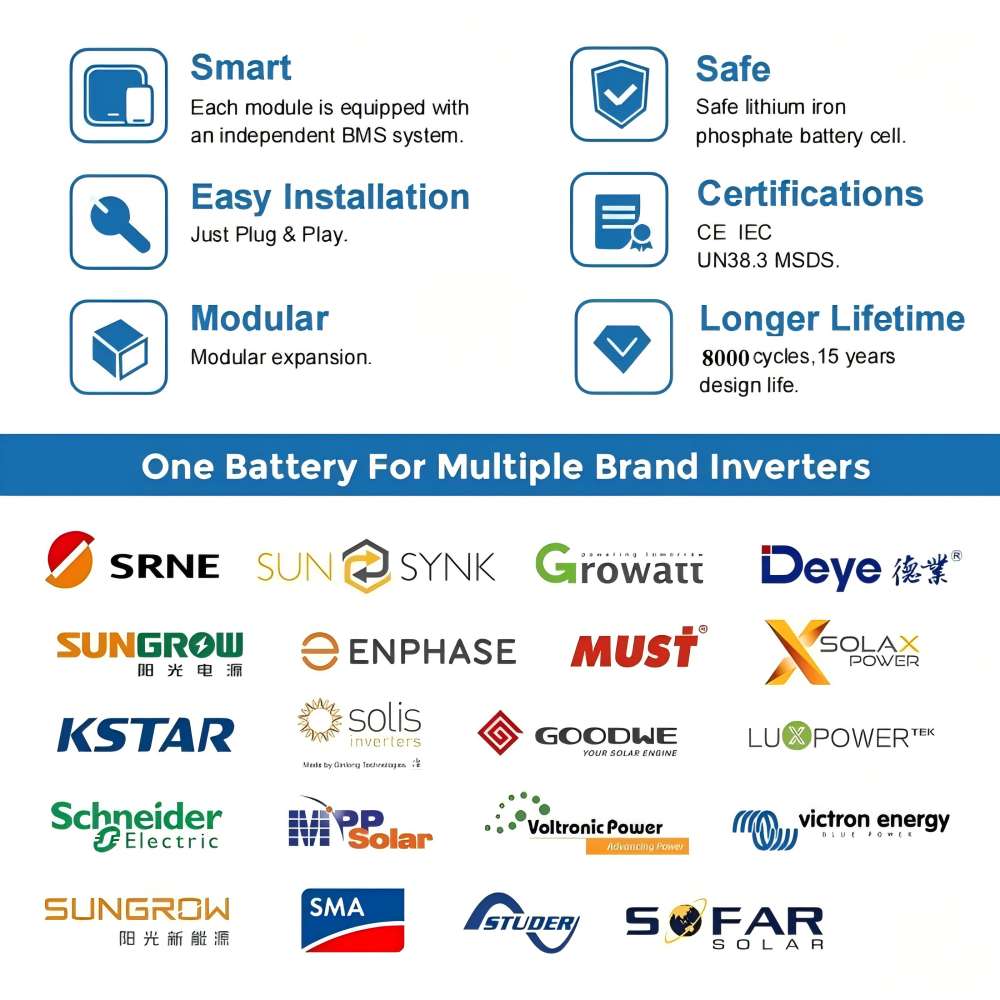
The pack is a 48 V-class unit — nominal 51.2 V is what makes it a 48v lifepo4 battery in system terms — and it is designed to sit on the DC side of a compatible inverter or charger. Settings differ between brands and generations: charge voltage, cut-off and communication all have to match. Send us the inverter make, model and firmware generation and we will tell you what to set, and whether anything else in the system should change before you buy.
Does the battery need regular maintenance?
No routine maintenance beyond keeping it dry and ventilated. A deep cycle lithium battery has no electrolyte to top up and no terminals to grease, and the management system handles balancing and protection on its own. What it does need is airflow and an occasional look at the display: clear the vents monthly, watch for alarm messages, and keep the cabinet out of direct sun. If the property is empty for months, store it charged rather than flat.
Can it charge from solar, the grid and a generator?
Yes — all three paths run through the inverter or charger. A lifepo4 lithium battery of this size is normally set up solar-first, with the grid covering poor-weather weeks and a generator as the last resort on off-grid sites. The inverter decides the order and the charge rate, so set those before commissioning and the pack will be filled the way your tariff and your fuel budget expect.
Can I move it around the property?
It sits on casters, so it can be rolled into position and moved during a refit — that mobility is the point of the mobile ESS format, and it is why the cabinet works as a battery storage power station for a workshop or a temporary site as well as a permanent plant room. Move it with the DC isolator open and the inverter shut down, then re-check the siting and airflow once it is in its new spot.
What temperature range does it work in?
The rated operating window is −20 °C to 65 °C, which covers unheated garages and hot plant rooms. The edges of the range are not where you want to live, though: running at 60 °C shortens life, and as a rule lithium packs should not be charged while they are below freezing. Deep cycle batteries of any kind last longest in a stable, moderate room, and this cabinet is no exception.