Product Overview
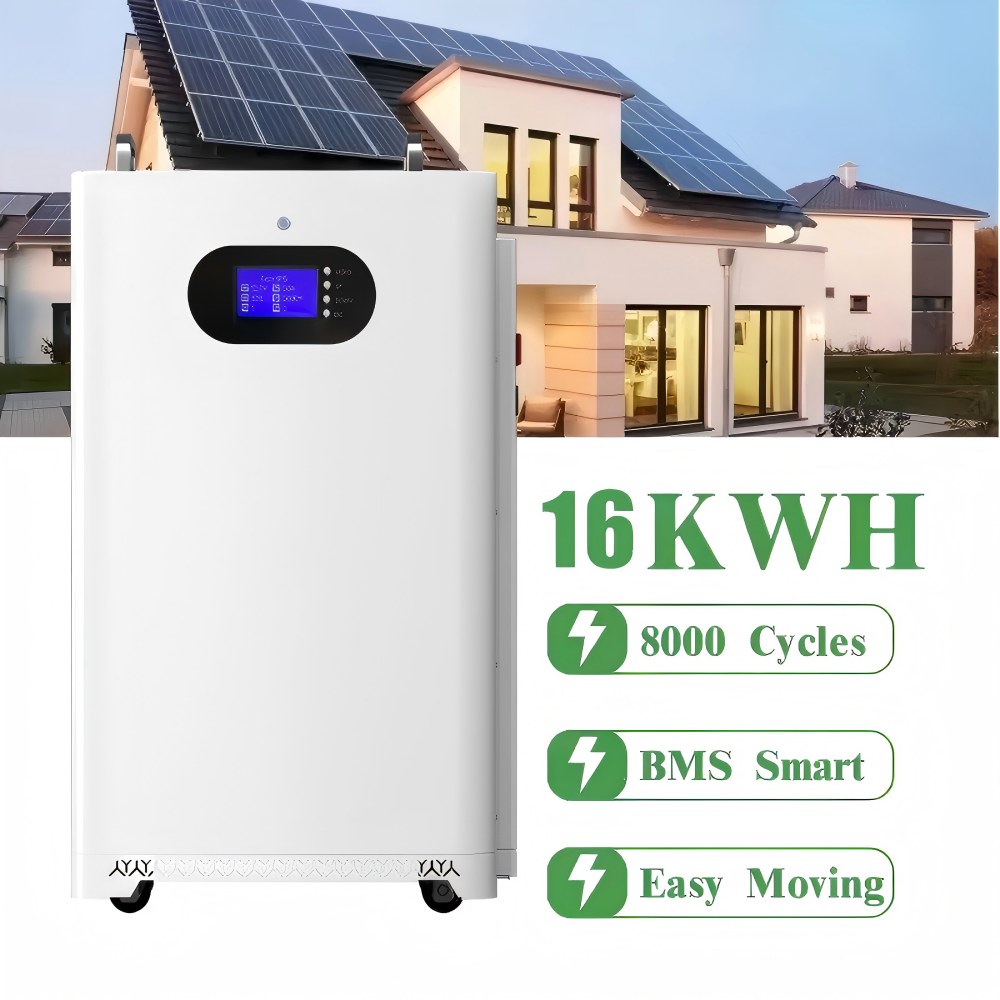
This is a 16.38kWh home battery built as one floor-standing cabinet: 320Ah of LiFePO4 cells at 51.2V nominal. Installers usually file that under a 48V LiFePO4 battery, because 51.2V is simply the sixteen-cell nominal figure for the 48V class — useful to know when you are matching the pack to an inverter and a charge controller that were specified for a 48V system.
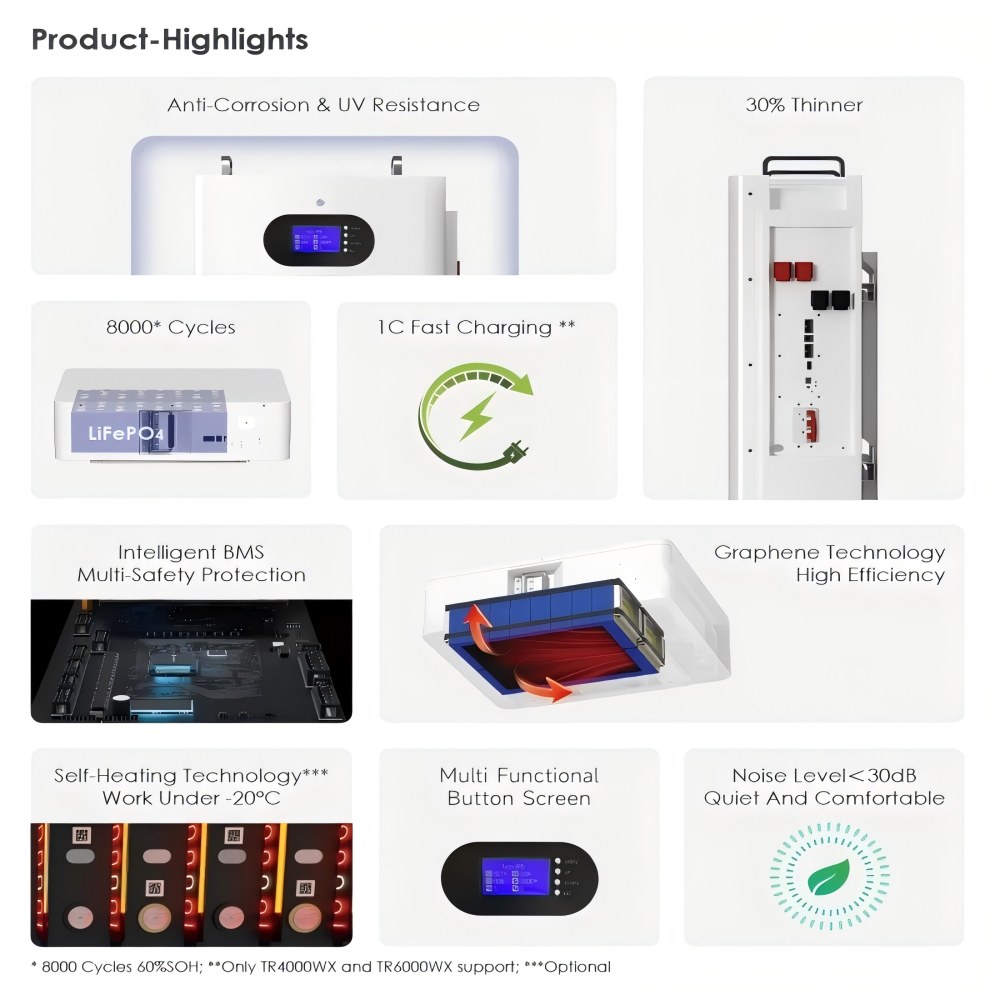
Most buyers arrive here from a lead-acid deep cycle battery bank that has stopped holding its capacity. The new pack stores more usable energy in a fraction of the footprint, needs no watering, and does not sag under load the way a tired flooded bank does. The cabinet rolls on casters and carries a front LCD, so it can be pushed into position and read without taking a cover off.
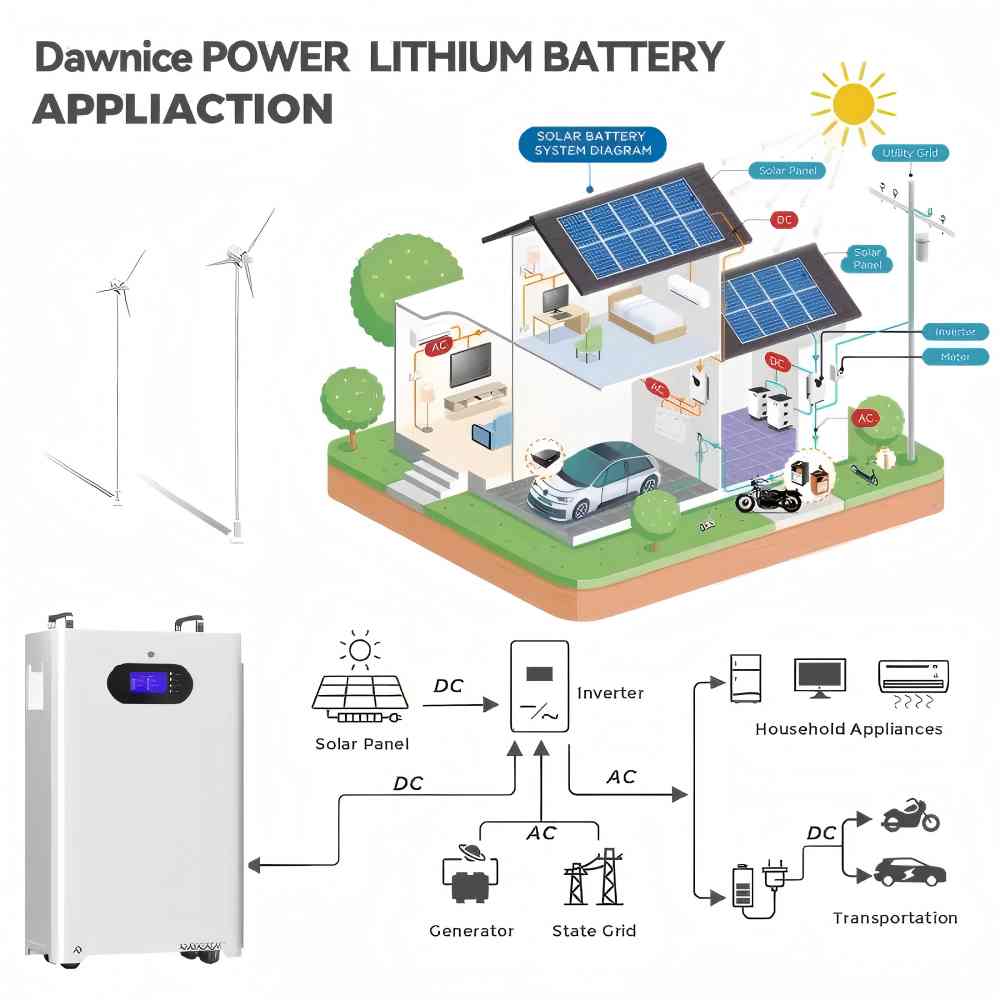
Day to day there is nothing to operate. The pack takes charge whenever production or the grid is ahead of the house load, holds it, and feeds the inverter when the load outruns supply. Balancing, protection and thermal management all run in the background, and the front panel shows state of charge, voltage and current at a glance.
Choose the 16.38kWh step when one evening of cover is not enough — a whole-house overnight run, a PV cabin that has to ride out two grey days, or a small workshop that wants a battery storage power station behind the counter. Smaller packs in the range do the same job for lighter daily consumption; this one is for the installations where the reserve itself is the point.
Battery Management & Balancing
Sixteen cells in series only deliver their rated capacity while they stay level with each other. This pack uses an active balancer: instead of burning off excess charge from the strongest cell as heat, it moves charge across to the weaker cells during normal running, so usable capacity does not quietly shrink around the weakest link. Over years of daily cycling, that is the difference between a LiFePO4 lithium battery that still tests close to spec and one that tapers off early.
The battery management system watches cell voltage, pack current and temperature continuously. It stops charging at the top, stops discharge at the bottom, and steps in on over-current, short circuit or thermal events before they become damage. Thermal management is part of that same loop rather than an add-on.
In practice you do not need to baby the pack, and you do not need to schedule equalisation charges the way lead-acid owners do. A pack with a working balancer and a working BMS is a maintenance-free device: the front panel tells you when something is outside its range, and the protection layer acts on it.
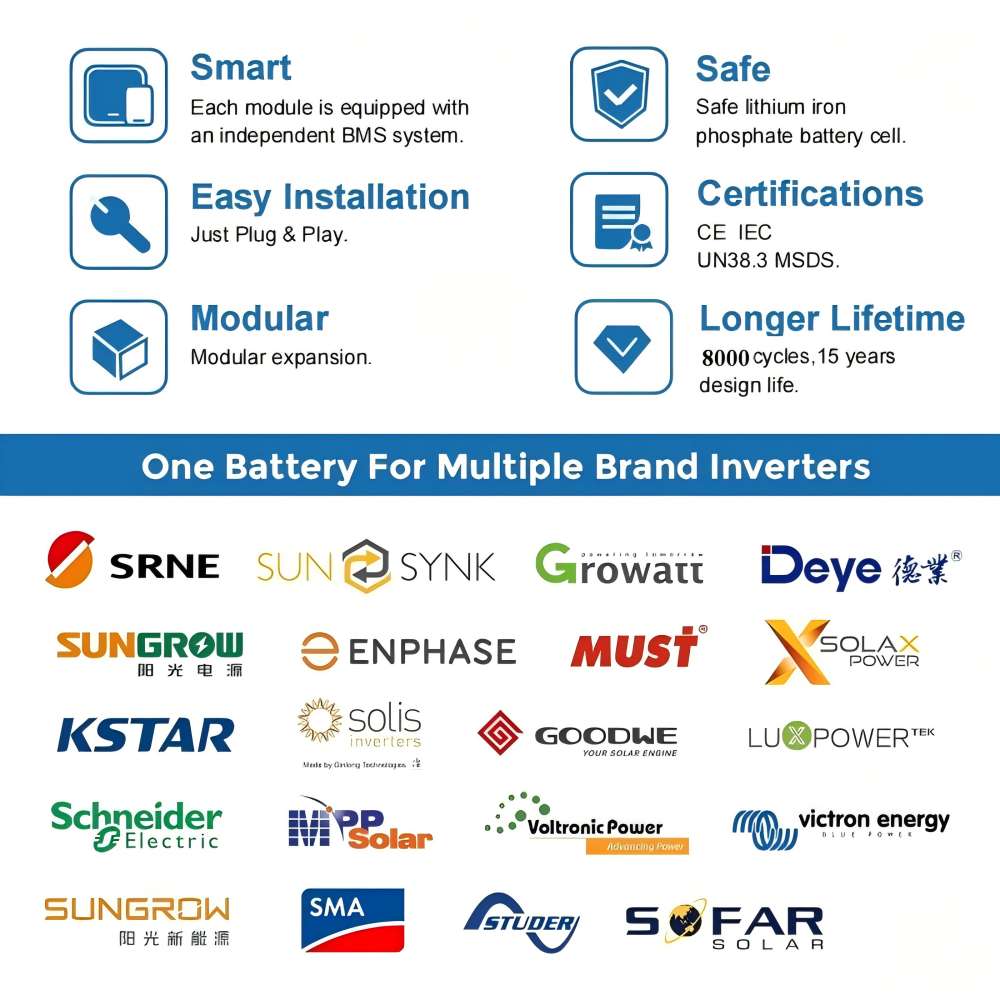
The unit is documented against UN38.3 for transport, IEC62619 for stationary battery safety and RoHS for restricted materials. Those are the marks that matter when an installer signs a system off or an inspector asks for paperwork — tell us if you need the current documents on file with your order.
Charging Methods
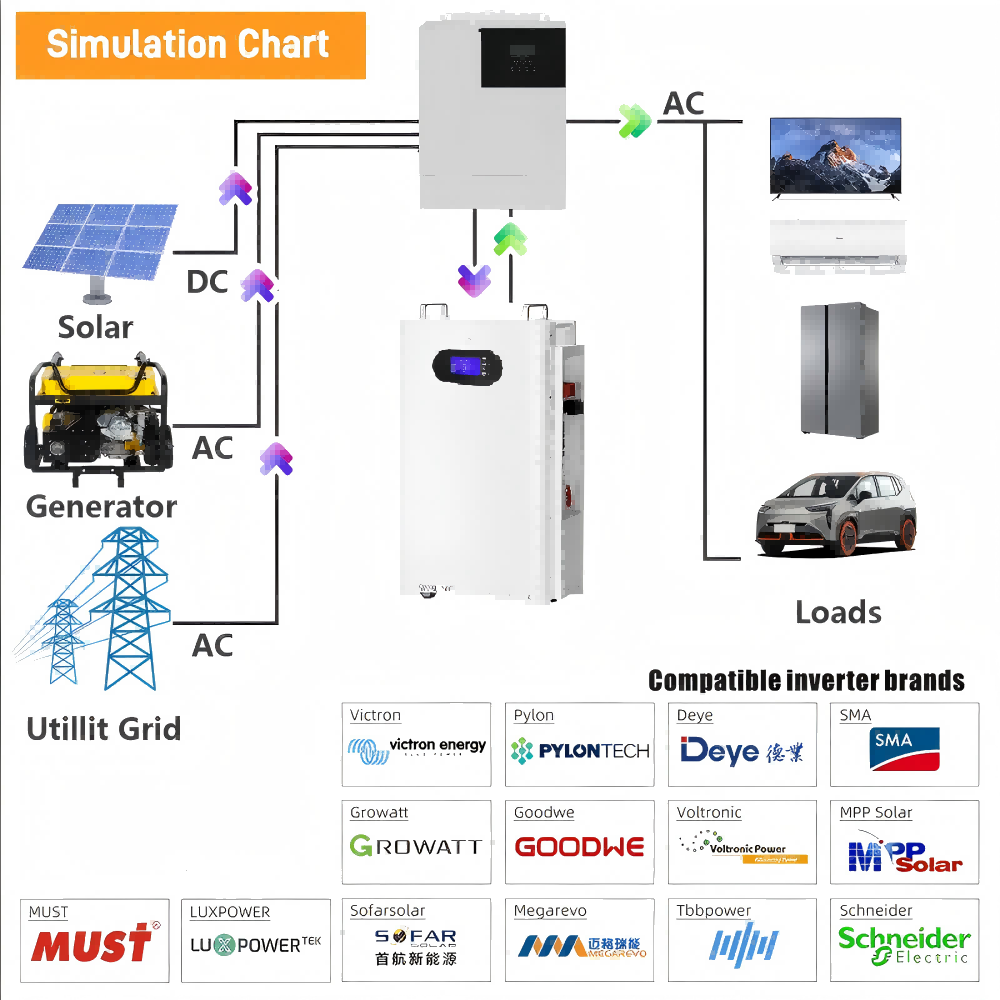
- Three ways in. The pack accepts charge from the utility grid, a generator or a solar array, so a cloudy week does not leave you waiting for sunshine and a long outage does not depend on the grid coming back.
- Match the profile. Absorb voltage is 58.4V and the discharge cut-off is 43.2V. Set your inverter or charger to a LiFePO4 battery charger profile at those figures; a lead-acid profile will either stop short of full or push past the safe top.
- Standard charge is 80A, which refills a 320Ah pack from empty in about four hours. The pack will take up to 200A if your system can supply it, cutting that to roughly an hour and a half.
- Check the 48V LiFePO4 battery settings on your inverter. A sixteen-cell pack needs the sixteen-cell voltage window; a profile left over from a fifteen-cell pack or a lead-acid bank will misread state of charge and can nuisance-trip.
- Size the source against the charge current. A generator has to carry the charge current plus the house load at the same time, and a solar array has to deliver enough kilowatt-hours a day to refill what you use, not just enough peak watts.
- Ask before you connect. Send us the make and model of your inverter or charger and we will confirm the profile and the current limit before the first charge.
Backup Time by Load
- Start with watt-hours, not amp-hours. The pack stores 16,384Wh at 51.2V and 320Ah. Add up the watts of the circuits you want to keep alive, divide into that figure, and you have your hours before inverter losses.
- A light overnight load of around 500W — fridge, lights, router, TV, a few chargers — runs for roughly 32 hours on a full pack.
- A heavy 2,000W load — cooking, water heating, a large air conditioner — brings that down to roughly 8 hours. Same battery, very different answer; the load list matters more than the number on the box.
- A lead-acid deep cycle battery bank of the same nominal voltage would deliver noticeably less of that, because only part of its rated capacity is usable and that fraction shrinks as the bank ages.
- Plan against usable energy. Cycle life is rated at 80% depth of discharge, so treat about four-fifths of the pack as your working reserve and keep the rest as outage headroom.
- Motor starts are a separate question. Fridges, pumps and compressors pull several times their running wattage for a second or two, and the 300A peak discharge rating is what carries those without tripping.
- Compare the steps in this deep cycle lithium battery range honestly. The 300Ah model stores 15.36kWh; this 320Ah version adds a little over 1kWh, worth roughly two extra hours at a 500W load or a wider margin on a cold night.
- Then leave a margin. Inverter efficiency, cable length and pack age each shave a few percent. A plan that lands at 90% of capacity is comfortable; a plan that lands at 100% is not.
Specifications
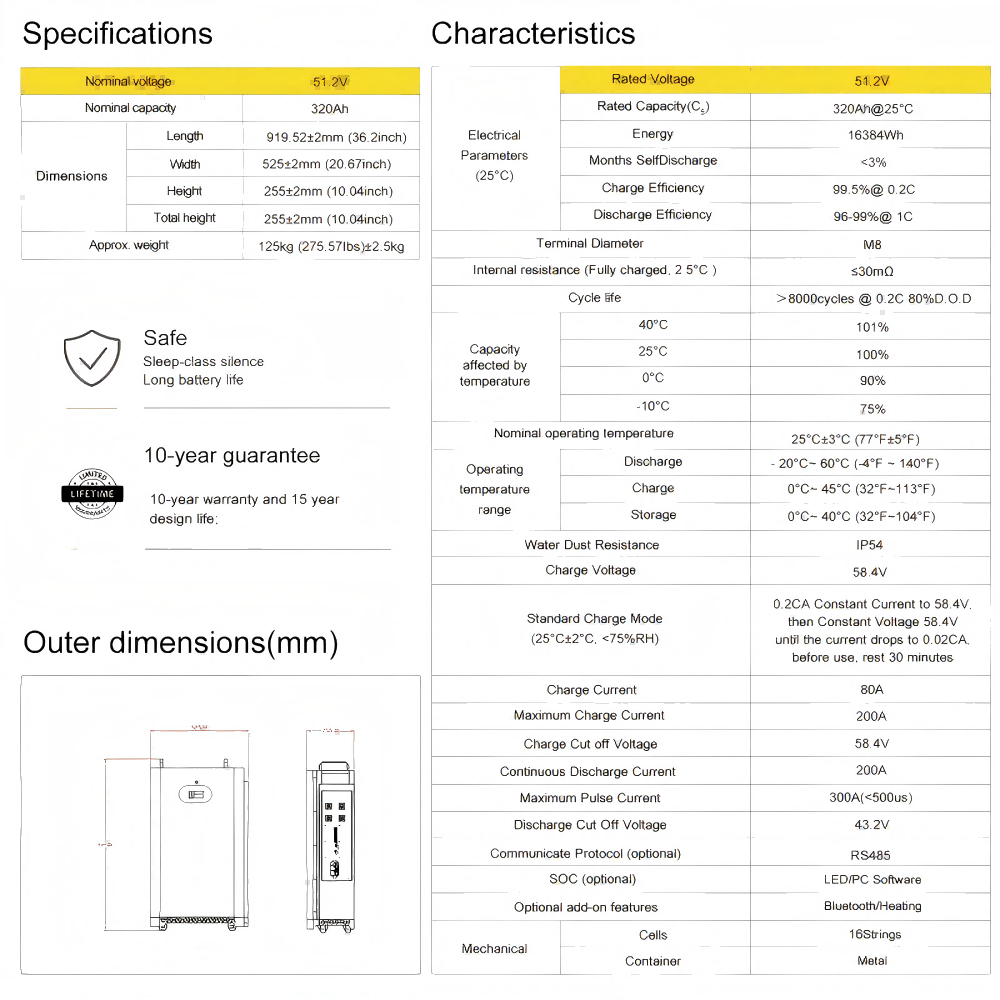
| Model | B-16KWH |
|---|
| Battery chemistry | LiFePO4, 16S1P |
| Nominal voltage | 51.2V |
| Nominal capacity | 320Ah |
| Total energy | 16,384Wh (16.38kWh) |
| Cycle life | 8,000 cycles at 0.2C / 25 °C / 80% DOD |
| Charge voltage | 58.4V |
| Discharge cut-off | 43.2V |
| Standard / maximum charge current | 80A / 200A |
| Continuous discharge current | 200A |
| Peak discharge current | 300A |
| Operating temperature | -20 °C to 65 °C |
| Parallel expansion | Up to 16 units (4,800Ah / 240kWh) |
| Compliance | UN38.3, IEC62619, RoHS |
Cycle Life & Running Cost
The cycle rating is quoted at 0.2C discharge, 25 °C and 80% depth of discharge — three conditions worth reading, because heat, fast discharge and deep cycling all shorten life. Treated well, a pack in this class runs for a very long time: one cycle a day against the rated count works out to more than twenty years of cycling, which is why the practical planning figure is the 10-year design life rather than the cycle count itself.
The economics are less about purchase price than about how many times you buy. A lead-acid deep cycle battery bank in the same role is heavier, takes more floor space, loses usable capacity as it ages, and gets replaced several times over the period this pack is designed to serve. Add the watering, the equalisation charges and the voltage sag under load, and the running-cost gap is wider than the gap on the sticker.
Standby draw is under 1W, so the pack is not quietly draining itself between cycles. What does shorten life is heat and habit: a cabinet in a hot, unventilated corner, or a system that runs the pack down to cut-off every single day. Keep the position cool and the reserve above cut-off, and a deep cycle lithium battery ages on a gentle slope instead of a cliff.
Capacity does fade, slowly and predictably. Expect a gradual drift over the first years rather than the sudden drop that ends a lead-acid bank's working life. If you see a step change rather than a slope, that is a signal to check the front panel and the DC connections rather than a normal ageing curve.
Parallel Expansion
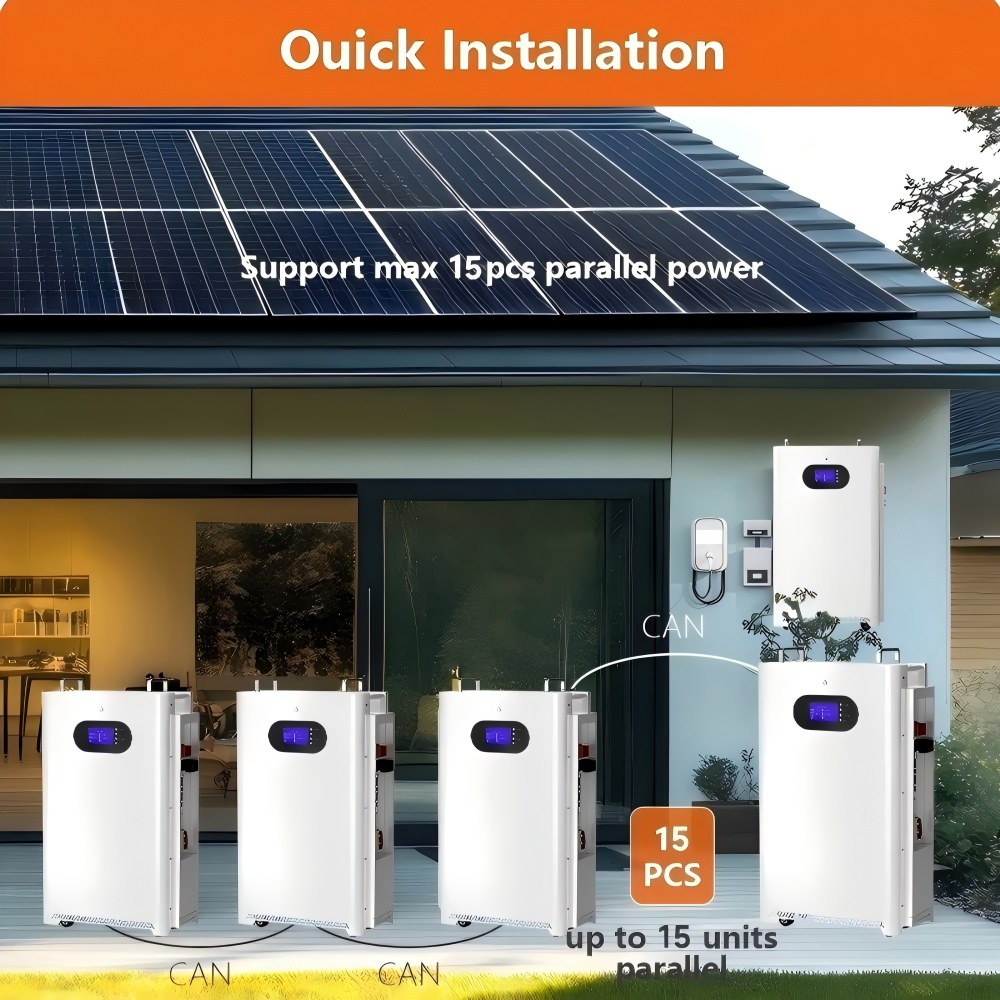
One cabinet is a complete system; it is also the first module of a larger one. Up to 16 units can run in parallel, taking the bank to 4,800Ah and roughly 240kWh — enough for a small commercial site, a cluster of farm buildings, or a house that keeps adding load. That headroom is the practical argument for buying a battery storage power station rather than a sealed all-in-one box.
Each cabinet keeps its own management system, so a fault in one unit does not take the whole bank down. That independence is what makes a LiFePO4 lithium battery cabinet easier to grow than a single sealed unit: you add capacity without touching what already works.
Plan the parallel wiring properly. Equal-length DC runs to a common busbar, per-unit fusing and matched cable gauge keep the units sharing current evenly; a lopsided install makes one cabinet work harder than the rest and age faster.
When you add capacity later, stay with the same model and a similar age where you can — putting a new pack beside a well-worn one on the same bus invites the older pack to drag the newer one down. If you already know the load will grow, say so now and we will plan the bank from the start.
Installation & Placement
- Measure the route before the unit arrives. The cabinet rolls on casters, but it still has to clear doorways, thresholds and turns. Check the delivery path and the final position at the same time.
- Choose a dry, ventilated spot within DC cable reach of the inverter. A utility room, garage or plant room works; standing water, direct weather and sealed cupboards do not.
- Confirm the temperature band. The pack is rated from -20 °C to 65 °C. If your garage spends winter below that, or the spot sits in direct summer sun, pick another wall.
- Leave working room. You want clear access to the front panel and enough clearance to roll the cabinet out later for service.
- Isolate before landing the DC cables, then torque the terminals to the figures in the manual — a loose DC connection is a hot spot waiting to happen.
- Commission the inverter profile before the first charge. Set the sixteen-cell voltage window, power up, and read the front panel to confirm voltage and state of charge before closing the load breaker.
- Record a baseline. Note pack voltage and the commissioning date; it makes any later conversation about capacity much quicker.
Ordering & Delivery
- Lead time. Stock orders are processed in 3–7 days. Custom builds take around 35 days.
- Shipping. Units ship from stock held in our local warehouses, with 3–7 days for shipping.
- Warranty. The pack carries a 5-year warranty.
- Returns. A 30-day return window applies — contact us within 30 days of receiving the unit.
- Warehouse. Stock is held in the USA, China and Dubai; choose the one that suits your address and timing when you order.
- Before you order, send us three things: the inverter make and model, the load list you want to back up, and where the cabinet will stand. We will confirm the LiFePO4 battery charger profile, check that 16.38kWh suits the load, and flag anything about access before dispatch.
- Not sure it is the right size? Send the load list anyway. If a smaller battery storage power station would cover it comfortably, we will tell you so.
- Fitting more than one? If you are installing these across several properties, or planning a parallel bank from day one, talk to us about project quantities and staging.
About Our Company
Xinyubattery is the brand of Shenzhenshi Xinyu Newenergy Technology Co.,LTD, a Shenzhen-based company founded in 2016 and working in green power solutions for more than ten years. Through a vetted network of production partners, we bring a broad range of power products together in one place and consolidate each order for you. Products are checked before dispatch, packed for export and shipped from local stock, and our team stays available for technical advice, fitting questions and after-sales help.
FAQ
Is 51.2V the same as a 48V system?
For practical purposes, yes. 51.2V is the nominal voltage of sixteen LiFePO4 cells in series, which is what the trade calls a 48V LiFePO4 battery. Inverters and chargers specified for the 48V class are the right match. What has to be set correctly is the sixteen-cell voltage window — 58.4V at the top and 43.2V at cut-off.
How large an inverter can it feed?
The pack is rated at 200A continuous and 300A peak. At 51.2V nominal, 200A works out to about 10.2kW of continuous draw, and the 300A peak absorbs motor and compressor starts for a short burst. Size the inverter so your normal load stays under the continuous figure, and treat the peak rating as surge cover rather than something to design your average load around.
Can it go in an unheated garage or outdoors?
The operating range is -20 °C to 65 °C, so a garage that stays inside that band is fine. Two things to avoid: a position in direct summer sun, where the cabinet runs hotter than the air around it, and any spot where water stands or sprays. It is built as an indoor cabinet, so if the only option is full exposure to weather, plan an indoor run instead.
Do I need a special charger?
You need a charger or inverter with a LiFePO4 profile, not a lead-acid one. Set absorb to 58.4V and cut-off to 43.2V, then check the current limit: standard charge is 80A and the pack will accept up to 200A. If your existing lifepo4 battery charger only offers fixed lead-acid modes, it is the wrong tool for this pack and should be replaced rather than run on the wrong curve.
What maintenance does it need?
Very little. There is no water to top up and no equalisation schedule. Check the front panel occasionally, keep the terminals clean and dry, keep vents clear of dust and stored boxes, and look over the DC connections once a year. Balancing and protection are handled by the management system in the background.
Can I keep my old lead-acid batteries on the same system?
No. Lead-acid and a LiFePO4 lithium battery need different charge voltages and behave differently under load, so on a shared bus one of them is always being charged wrongly. Take the old bank off the system when the new pack goes in, and change the charger profile at the same time.
Why choose this 320Ah model over the 300Ah one?
The 300Ah version stores 15.36kWh and this one stores 16.38kWh — a little over 1kWh more, which is roughly two extra hours at a 500W load, or a wider margin on a cold night when a heat pump is running. If your load list fits inside the smaller pack with room to spare, the smaller one is the sensible purchase. This deep cycle lithium battery is for the installs where the reserve is already tight.